
Top 7 Marketing Miner Features to Drive More Paying Customers
Want more traffic and more sales? First, your customers need to find you - both on Google and across AI search engines. Marketing Miner is an SEO and AI tool that delivers clear, reliable data to help your business grow. Whether you’re an SEO pro, PPC specialist, copywriter, marketer, or e-commerce owner, it gives you the exact insights you need to scale.
There are endless ways to use the platform, so we narrowed it down to the essentials. Here’s how to get the most out of Marketing Miner - from the basics to advanced data deep-dives.
1. Give Your AI Assistant Real Search Data - Connect ChatGPT and Claude to Marketing Miner (via MCP)
Do you use ChatGPT or Claude to write web copy, optimize pages, analyze competitors, or plan campaigns? The catch is that AI assistants don't have access to live market data. They don't know real search volumes, which keywords your competitors rank for, or where your own site is invisible. Without these numbers, their answers are often just generic guesses - or worse, pure hallucinations.
That’s exactly what Marketing Miner’s AI integration via MCP (Model Context Protocol) solves. MCP creates a direct bridge that lets ChatGPT or Claude fetch search and website data straight from Marketing Miner’s database. Instead of constantly switching tabs and copying numbers back and forth, your AI assistant pulls what it needs mid-conversation and answers based on real-world data. You don’t need any technical skills, and you work directly inside the AI interface you're already familiar with.

This takes your AI workflows to a whole new level. Here are a few things you can ask your AI assistant to do:
- Find search volume and quick-win opportunities - Ask: “What were the most searched mountain bike topics over the past month?” and get content ideas backed by real search volume.
- Expand your product catalog based on demand - Compare search demand across products or services you’re planning to launch, and bet on what people are actually searching for.
- Run instant competitor analysis - Prompt it with: “What keywords does my competitor rank for, and how much traffic do they bring in?” The AI pulls the numbers directly from Marketing Miner.
- A data-backed partner for business decisions - Base major moves on hard data - from how many people search for a topic, to which landing pages work for competitors, to emerging trends and search seasonality.
2. Discover What Your Customers Are Actually Searching For - 1-Click Keyword Research
Do you name your products or services using industry jargon? Your customers might search on Google completely differently. Instead of formal terms like "casual footwear," they simply search for "sneakers" or "everyday shoes." The gap between the phrasing you use and what your customers actually type can cost you thousands of lost visits - and missed revenue handed straight to your competitors.
Before building new categories, writing product copy, publishing blog posts, or spending ad budget, validate real search demand. Don't risk optimizing for "ghost keywords" that nobody searches for or creating content around topics with zero interest.
With Marketing Miner’s Keyword Profiler, you can uncover the exact terms and questions people search for in seconds, complete with all the essential metrics - search volume, cost per click (CPC), year-over-year (YoY) change, keyword difficulty, and search trends.
Try it right now. Enter a topic below and see what your customers really care about:
How the Keyword Profiler Works
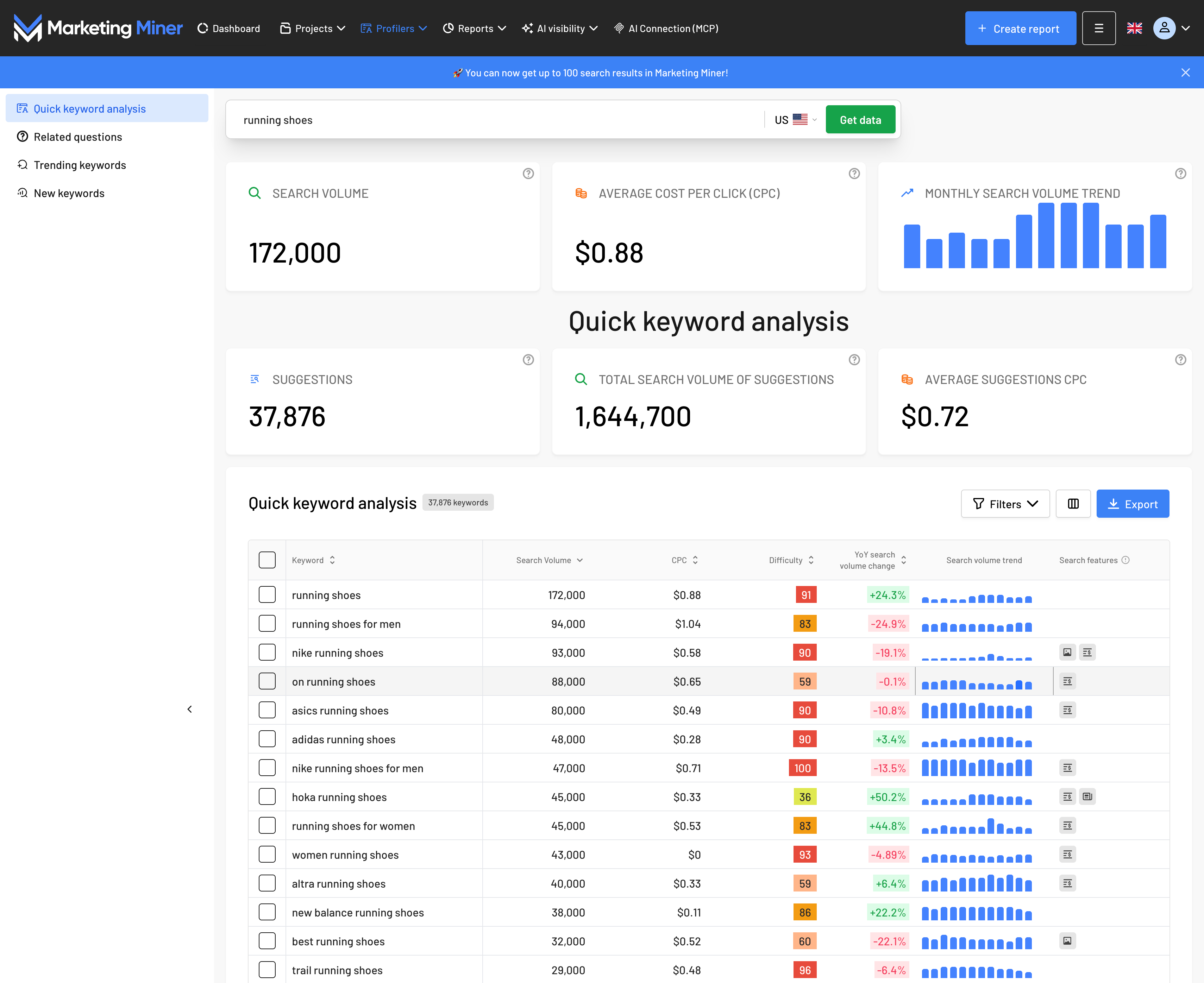
Enter a seed keyword (e.g., "running shoes"), select your target country, and Marketing Miner shows you:
- Average monthly search volume on Google.
- Average cost per click (CPC) in Google Ads.
- Search volume trends - Seasonality and search trajectory over the past 12 months.
- Keyword suggestions - Related queries for the analyzed phrase (including search volume, CPC, competition, YoY trends, and SERP features).
- Questions - Real queries people ask around the topic - ideal inspiration for blog content or FAQ sections.
- Trending keywords - Breakout terms that have seen search volume more than double compared to the previous 12 months.
- New keywords - Emerging search queries that started gaining traction on Google over the past year.
You have a keyword list - what’s next?
Finding the right keywords is only step one. Putting them into practice is what actually drives rankings, traffic, and sales. Here’s how to apply them day to day:
- Optimize your site architecture and category naming - Don't guess what to name a new e-commerce category. If the data shows people search for "running shoes" significantly more often than "jogging footwear," use that exact phrase in your category name, URL slug, and title tag so shoppers can actually find you.
- Write content people actually want to read - Use the Questions tab as an editorial roadmap for your blog or FAQ section. Answering specific questions (like “How to choose trail running shoes”) attracts qualified visitors who are trying to solve a specific problem, building the trust and topical authority that turns readers into buyers.
- Structure headings that work - Place your core keywords naturally into your main heading (H1) and subheadings (H2, H3). This helps search engines understand the page's topical relevance while instantly reassuring visitors they landed in the right place.
- Lower PPC costs with long-tail keywords - Use CPC data to target high-intent long-tail keywords. Specific phrases (like “women's road running shoes”) are usually cheaper, face less ad competition, and boast significantly higher conversion rates.
Marketing Miner TIP: Need data for hundreds or thousands of keywords at once? You don't have to look them up one by one. The Reports section is built for bulk data processing. Just select the Search Volume miner, upload your keyword list, and Marketing Miner will pull metrics for any country in minutes.
3. See What’s Already Working for Others - Competitor Analysis in Seconds
Manually figuring out what drives your competitors’ success - the keywords they rank for, the traffic they bring in, their top-performing pages, or the ad campaigns they invest in - would take forever. With Marketing Miner’s Website Profiler, you can do it in seconds. Instead of guessing, you get accurate data on how competitors perform across organic search, paid ads, and Google AI Overviews.
How the Website Profiler Works
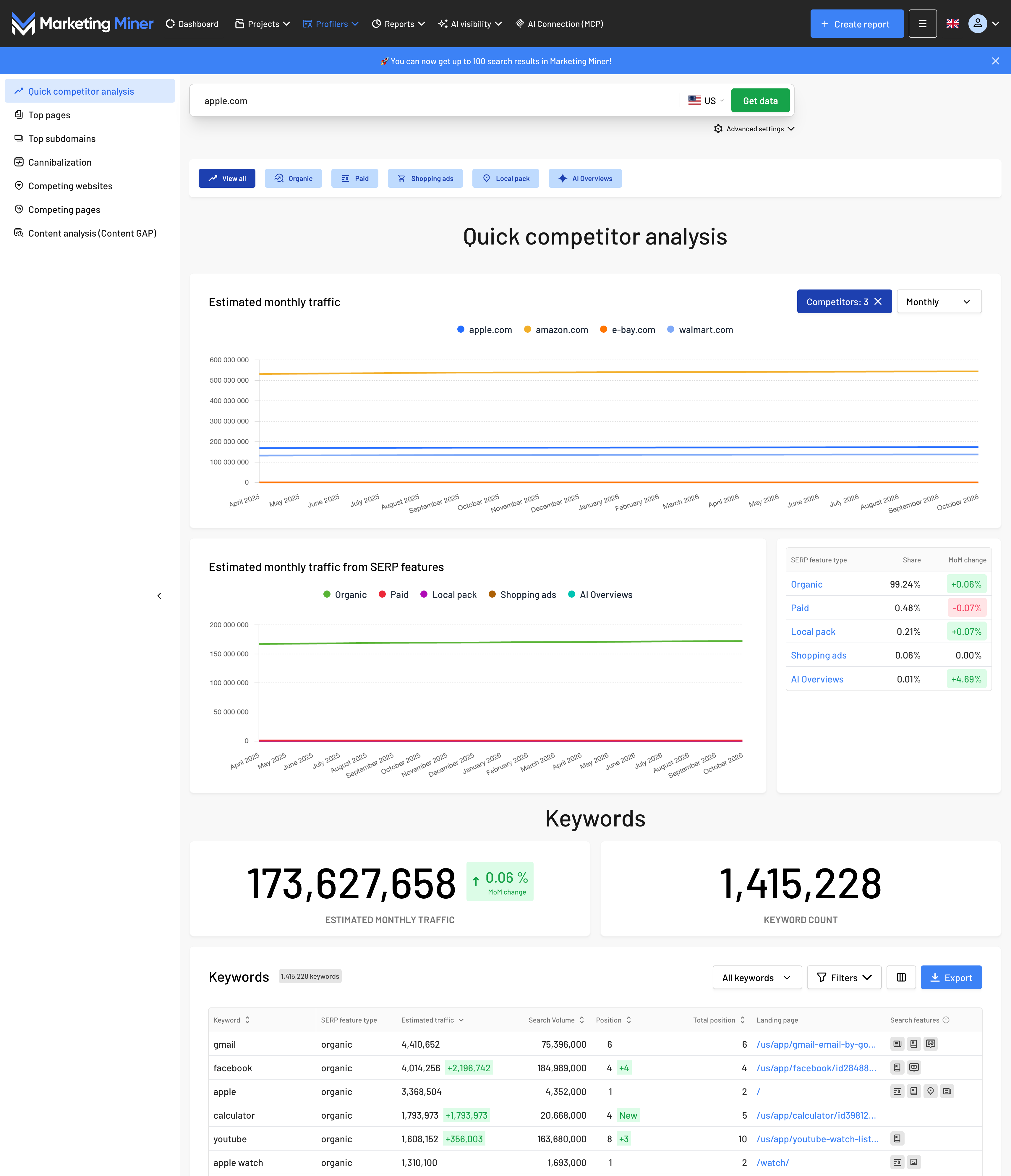
Enter a competitor’s domain or a specific URL (e.g., apple.com or www.apple.com/mac/), choose a country, and Marketing Miner gives you:
- Where their traffic comes from - A clear monthly traffic trend graph. Quick filters let you isolate traffic from organic search, paid search (PPC), Google AI Overviews, and more.
- Top-performing pages - The highest-traffic URLs responsible for driving the bulk of their visitors.
- Full keyword profile - See the exact search queries they rank for, the ranking landing pages, their current SERP positions, and estimated traffic.
- Overall organic footprint - Additional data to give you a complete view of your competitor’s search visibility.
Test your competition right now:
How to Put This Data into Practice
Competitor analysis isn’t just about "spying" - it’s about planning your next strategic moves:
- Spot content gaps - Compare your site against competitors to find valuable keywords they rank for that you're missing. These are your biggest opportunities for new product categories or high-traffic blog posts.
- Improve on what already works - Review their most-visited pages and reverse-engineer what makes them successful to create better content on your own site.
- Smarter ad spend - If you notice a competitor is bidding heavily on a specific product cluster, you can either counter with a stronger offer or pivot toward cheaper, overlooked segments.
- Track industry trends - If traffic to a competitor's specific product category is spiking, you know there’s rising market demand you can capitalize on.
Marketing Miner TIP: Want to review the numbers at your own pace or share them with colleagues? You can export the entire competitor overview to Excel with a single click.
4. Track Your AI Brand Visibility - See If ChatGPT and Other AI Assistants Recommend You
Search isn't just happening on Google anymore. People are increasingly turning to AI for buying recommendations: “What are the best running shoes for flat feet?” or “Where should I buy eco-friendly home goods?” If AI assistants aren’t citing your brand in their answers, you’re losing potential customers at the very start of their buying journey.
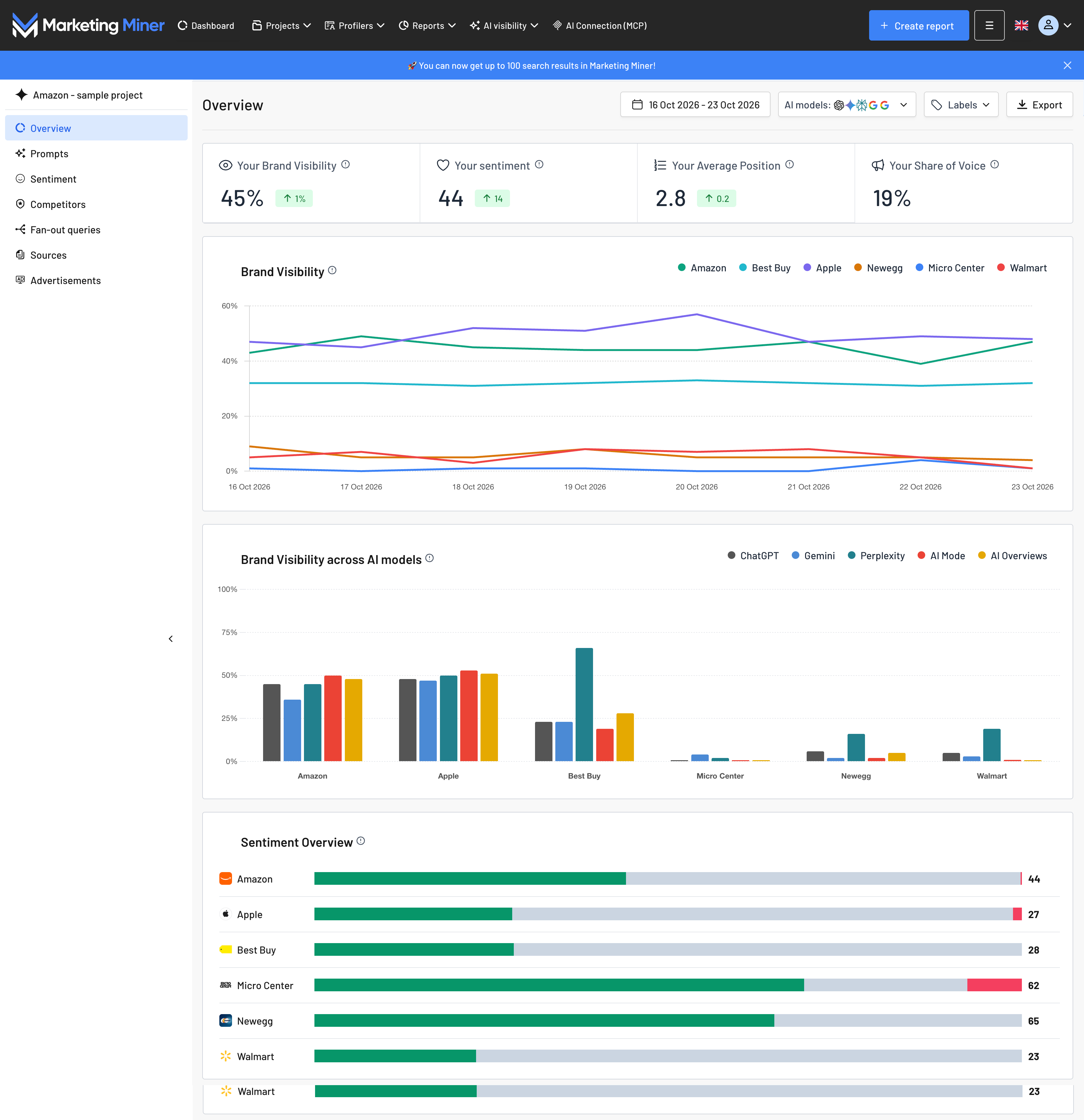
The AI Visibility Tracking in Marketing Miner reveals how your brand and competitors perform across ChatGPT, Gemini, Perplexity, Google AI Overviews, and Google AI Mode.
How AI Visibility Tracking Works
First, choose between regular tracking or a one-time analysis. Enter your brand name, up to 5 competitors, and upload the list of prompts where you want to track visibility. Marketing Miner queries the leading AI models for you, capturing the exact response a real user sees - in a live browser environment, using localized IP addresses. No synthetic API shortcuts.
- Regular AI Tracking - Track where, how often, and in what context AI assistants cite your brand and competitors. Monitor key performance metrics over time, including Overall AI Visibility, Sentiment, Average Ranking Position, and Share of Voice (SOV).
- One-Time AI Analysis - Get an instant snapshot of how you and your competitors appear across specific models. Beyond pure brand mentions, you can uncover the fan-out queries that engines like ChatGPT and Gemini generate internally to answer complex prompts, or run a deep-dive product analysis in ChatGPT.
Pricing and more details about the add-on
How to Put This Data into Practice
Tracking your visibility across generative search engines (GEO) is essential for modern marketing:
- Stay ahead of the competition - Are AI assistants recommending your competitors while ignoring you? Check which sources the AI cites and how it breaks down user queries. This helps you optimize on-page content so models can easily understand and reference your site next time.
- Fuel strategic decisions - Get clear, executive-ready data showing whether your brand is gaining ground or losing traction in the AI-driven search landscape.
- Protect brand reputation - Are AI models referencing your brand with negative sentiment or hallucinating outdated product details? Marketing Miner shows you exactly where to fix content and build external authority so AI engines present your brand accurately.
Marketing Miner TiP: AI assistants rely heavily on topical authority and off-page signals (third-party brand mentions, customer reviews, PR coverage). To win placements in AI answers, focus on original content - proprietary data, detailed case studies, hands-on product comparisons, and granular product specs. And don’t neglect traditional SEO - AI search engines frequently pull from pages that already rank at the top of Google’s organic results. High organic visibility remains the bedrock of AI search.
5. Keep Your Performance Under Control - Automated Rank Tracking
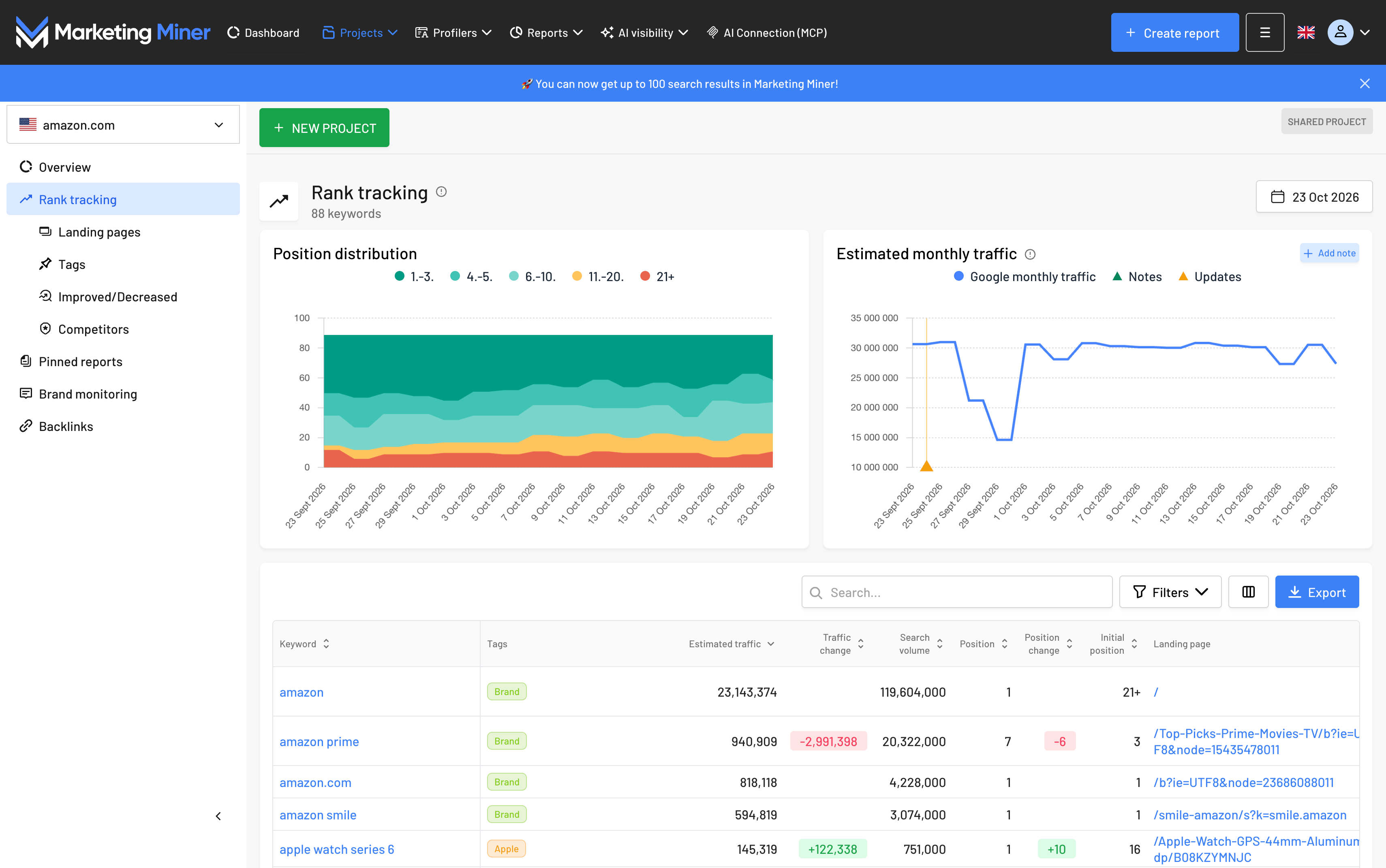
Without regular rank tracking, you won’t know whether the hours spent optimizing your site or the money invested in campaigns is actually paying off. In the Projects section, you can set up automated SERP tracking. Marketing Miner monitors your search rankings across Google on a daily or weekly schedule.
You can also benchmark against up to 5 competitors within a single project, track their ranking positions alongside yours, and monitor your overall Market Share. You’ll instantly see who is gaining ground in the SERPs and who is losing organic visibility.
How Regular Tracking Works in Projects
Simply enter your domain and the keywords you want to monitor. Marketing Miner automatically tracks your search positions every day or week (based on your chosen schedule). You get:
- Estimated traffic trends - A high-level view showing whether your organic traffic is growing, or in decline.
- Market Share overview - See the exact percentage of search visibility your brand owns compared to competitors across your tracked keyword universe.
- Winners and Losers (Movers) - A quick snapshot highlighting your biggest ranking gains and warning you about keywords that are dropping.
- Brand mention alerts - Automated notifications whenever someone mentions your brand, competitors, or core industry keywords on the web.
- Backlink health monitoring - If you invest in link building to grow domain authority, this automatically checks whether your earned backlinks are still live and functioning.
- Ranking position distribution - A clean chart showing how many keywords sit in the Top 3, Top 10, etc. positions.
- Granular keyword metrics - For every tracked phrase, see its estimated traffic, current vs. starting ranking position, search volume, and ranking landing page. Click through to view historical rank trends and logged SERP shifts.
How to Put This Data into Practice
- Hold agencies and freelancers accountable - Easily verify whether recent content updates or technical changes actually improved rankings and organic traffic for priority topics - giving you clear proof of ROI.
- React to ranking drops before sales fall - When positions drop for critical commercial categories, you catch it immediately - not weeks later when order volume dries up. This gives you time to fix the issue (refresh on-page copy, improve internal linking, or resolve technical errors).
- Protect and build your brand - Track brand mentions in real time to respond to user questions, address negative reviews, or reach out to turn unlinked mentions into authoritative backlinks.
- Benchmark against direct competitors - Identify which keywords competitors are using to outrank you. Do their pages feature better content depth, higher-quality images, or more reviews? Reverse-engineer their wins to reclaim the top spot.
6. Close Your Content Gaps - See What Your Competitors Rank For (and Where You're Missing Out)
Find out where competitors are outranking you and where you're leaving money on the table. Do you have a great website, but competitors are still beating you in organic search? It’s often because they cover topics and keywords you've completely overlooked.
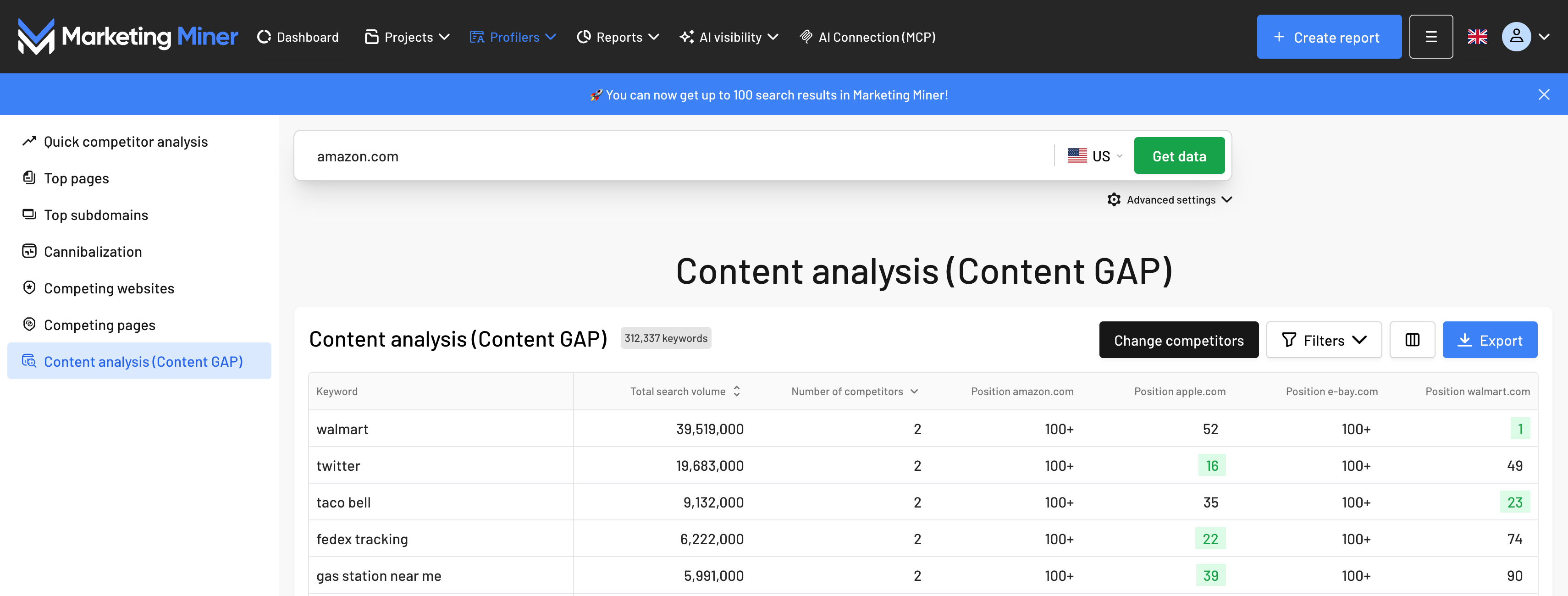
The Content Gap tool shows you, in a single click, all the keywords your competitors rank for on Google (along with their ranking positions) where your domain is completely missing.
Instead of cross-referencing messy spreadsheets, just enter your domain and up to 3 competitors. Marketing Miner does the tedious heavy lifting and hands you an actionable list of growth opportunities.
How to Put This Data into Practice
This analysis isn't just for SEO pros - it’s an actionable task list for anyone looking to maximize site traffic and revenue:
- Inspiration for new categories and products - If all competitors rank for "vegan protein powder" and you don’t, that's a clear signal to act. You might be missing that category entirely, using internal jargon instead of customer phrasing, or missing specific products that are driving shoppers to competitors.
- Editorial ideas that actually drive traffic - Discover the topics competitors are blogging about to pull in organic visits. This lets you build out your blog with content you already know people are actively searching for.
- Prioritize high-impact quick wins - You won't just see the search queries you’re missing; you'll also see where your competitors rank and how strong their visibility is. This helps you prioritize low-hanging fruit to generate a faster return on your marketing investment.
- Data-backed content briefs - Instead of vague instructions like “write something about fitness,” you can hand your copywriters a precise brief with the exact keywords, subtopics, and search intent needed to catch up with and outrank the competition.
Marketing Miner TIP: Export the entire keyword list to Excel with a single click. Sort by search volume descending to immediately see which content gaps are costing you the most potential customers.
7. Process Data for Thousands of Keywords and URLs - Content & Technical Audits in Minutes
Do you need to run a sitewide technical check on a massive e-commerce catalog, pull search volume for tens of thousands of keywords, or check the status of hundreds of backlinks at once?
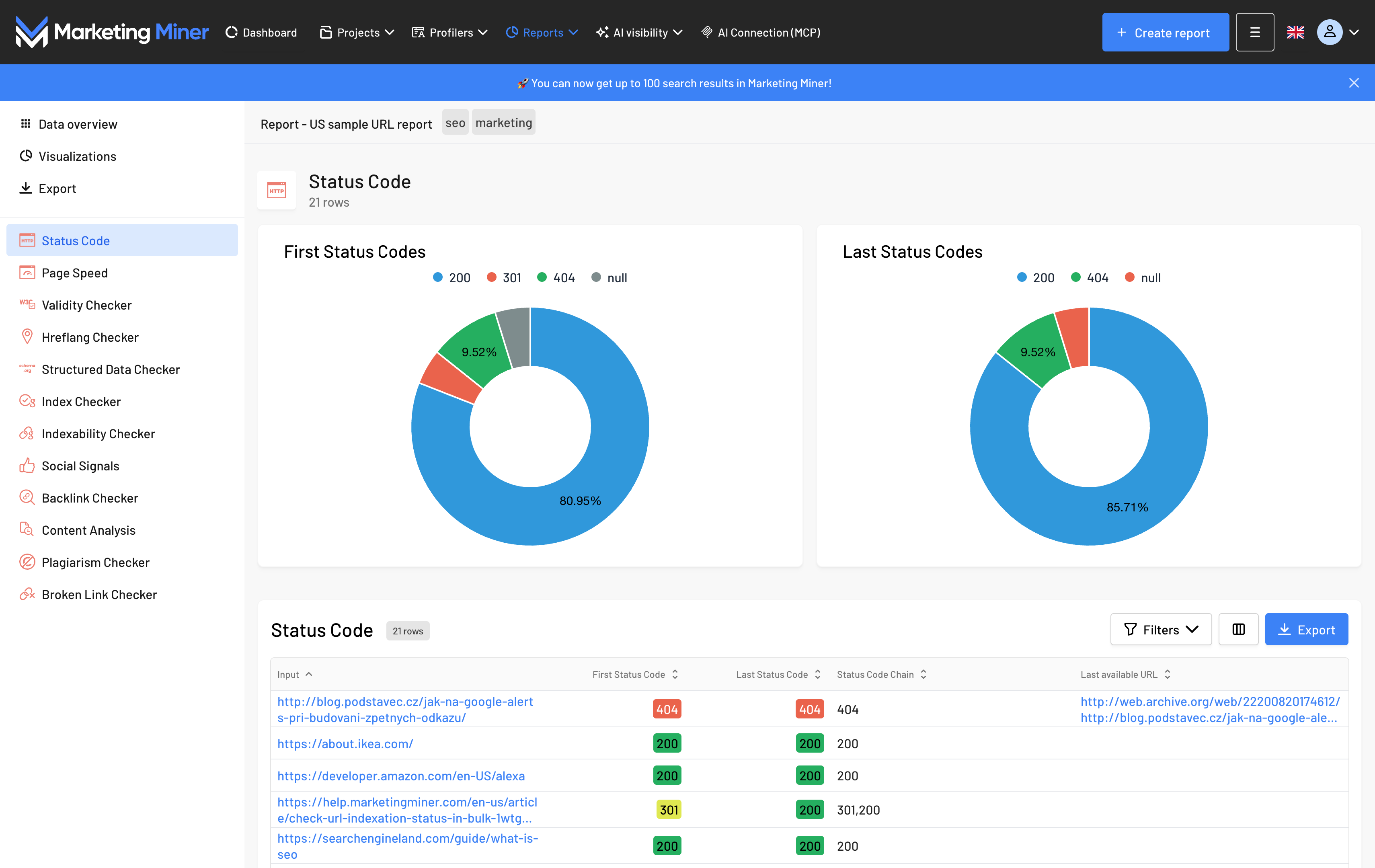
That’s exactly what the Reports section in Marketing Miner is built for. You’ll find around 30 automated data tools (Miners) designed for bulk technical and content auditing.
How Bulk Analysis Works
Select the specific tool you need, like Search Volume, Index Checker, or Content Analysis. Choose your target market and upload your list of keywords, URLs, or domains.
Marketing Miner processes the data asynchronously in the cloud. You can close your browser tab and focus on other tasks - we’ll send you an email notification as soon as your analysis is ready. Then, just download the final report (CSV/Excel) and start optimizing.
What Can You Do with Bulk Data?
Reports are essential for scaling up the following workflows:
- Keyword Research - Pull search volume and competition metrics for thousands of phrases at once, or generate bulk keyword suggestions. Use this data to map out site architecture, optimize H1 and title tags across hundreds of categories, or fuel large-scale editorial strategies.
- Technical SEO Audits - Check indexation status, HTTP response codes, and page speed metrics sitewide in one go. For example, use the report to isolate a list of broken internal pages (404 errors). Fix these by implementing 301 redirects to relevant products so shoppers don't hit dead ends and bounce to a competitor.
- Sitewide Content Audits - Extract title tags, meta descriptions, and header tags across your entire site. Are you missing meta descriptions on key product pages? Add them. These short snippets act as your organic ad copy and heavily influence whether users actually click on your search result.
- Link Building & Prospecting - Evaluate bulk backlink prospects and identify digital PR opportunities to earn high-quality links that drive referral traffic and boost your domain authority in Google’s eyes.
- SERP & Competitor Intelligence - Run bulk analyses of organic search results or see exactly who is bidding on specific keywords via Google Ads (and read their ad copy). Reverse-engineer their messaging to write more compelling ads and meta titles.
Put Marketing Miner into Practice
Stop relying on guesswork. Start growing your organic revenue with actionable search and AI intelligence. Create your Marketing Miner account today.
Would you rather have an expert walk you through the setup? We’d love to show you how to tailor the platform to your specific business model. Book a free demo call.