
Key SEO and AI News for November 2026
October was another packed month across SEO and AI search, bringing plenty of noteworthy updates worth your attention. Google shed light on crawling and indexing timelines, tweaked how links appear in AI Overviews and AI Mode, and expanded data filtering options in Search Console. We'll also dive into the poisoned SERP issue currently skewing rank tracking across SEO tools - and show you how we're tackling it at Marketing Miner. Plus, we'll introduce our new Marketing Miner SEO Skill, which equips your AI assistant with expert SEO know-how, and share actionable tips and resources to optimize your websites and online stores.
1. Google reveals crawling, indexing, and SERP update timelines
How long does Google actually take to discover a new page, index its content, or reflect changes in search results? Gary Illyes from Google answered these exact questions during October's Search Central Live Deep Dive conference in Barcelona, presenting previously unreleased internal data on typical and worst-case timelines across key search processes.
As reported by Barry Schwartz on Search Engine Roundtable, the presented data shows that Google typically discovers a new URL in about 20 hours, whereas recrawling an existing page takes around 30 days. Indexing itself can take roughly 1.5 hours - though only once Google reaches the page and all prerequisite stages are complete. Title and snippet updates usually take 1-2 days to reflect in the SERPs, while canonical URL changes can take anywhere from 1 to 3 weeks. For site migrations and other large-scale changes, Google typically estimates 1-3 months.
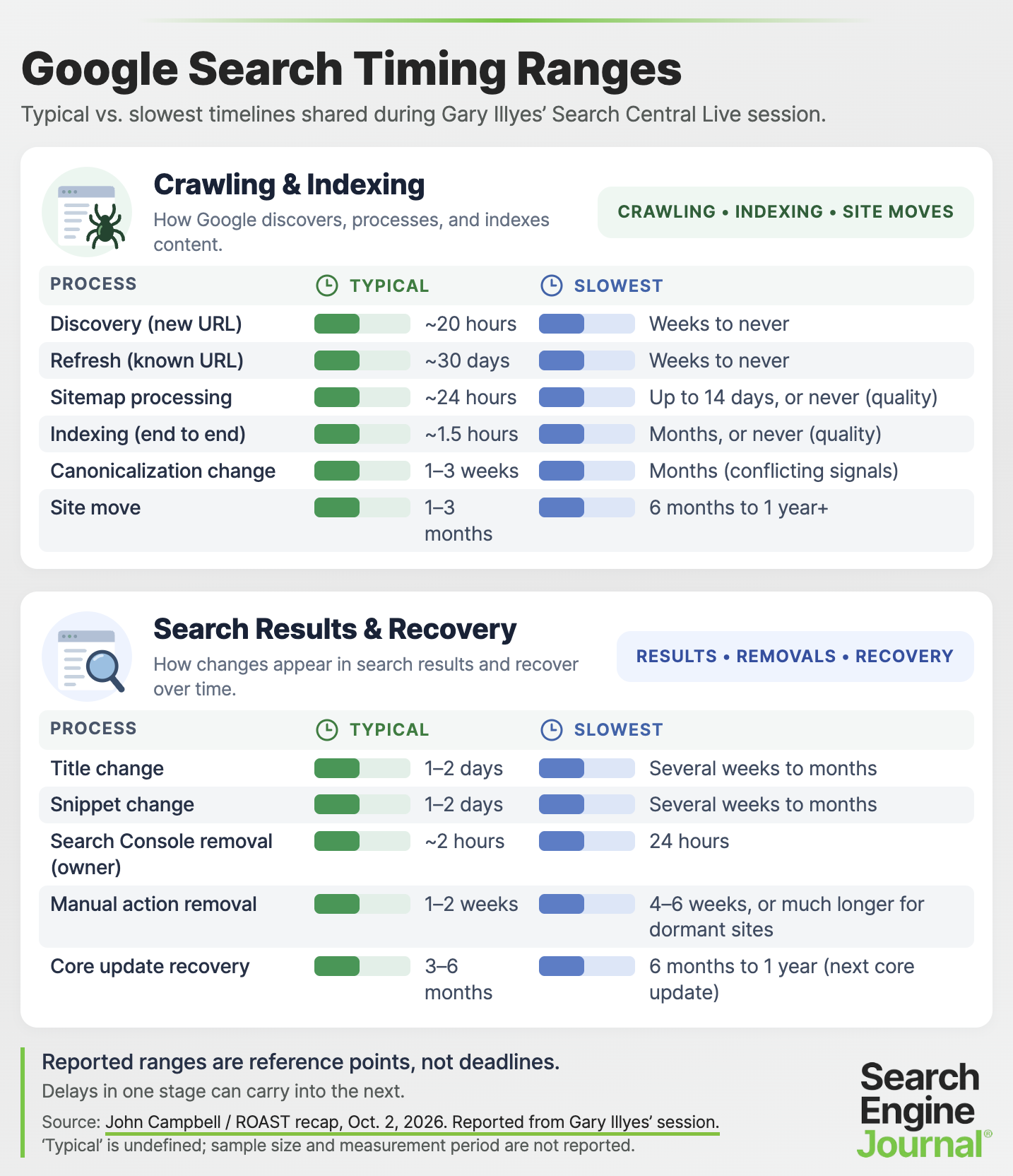
Source: Search Engine Journal – Google Crawling, Indexing & Recovery Timing Ranges
The data on recovering from algorithm updates is equally revealing. According to the presentation, recovering from a Core Update can take about 3-6 months, and in some cases even longer. Illyes also cautioned that these search processes are sequential, meaning delays compound. These numbers should therefore be taken as directional benchmarks rather than guaranteed turnaround times.
For SEO professionals and site owners, this is an invaluable benchmark that sets realistic expectations for how long Google needs to process new URLs and on-site updates. If your recent changes don't show up in search results right away, it doesn't necessarily point to a technical issue.
2. Marketing Miner SEO Skill: Equip your AI assistant with senior SEO expertise
Want to use AI to create high-quality content for your website or e-commerce store that actually drives traffic from both organic and AI search? Simply asking ChatGPT or Claude to write an article, product description, or category copy isn't enough. For AI to genuinely help with SEO, it needs clear guidelines, proven best practices, and real search data. That's exactly why we built the Marketing Miner SEO Skill - to equip your AI assistant with the expert know-how it needs.
It's a structured framework of rules and workflows that you can easily upload to your AI assistant. Packed with over 22,000 words of vetted SEO know-how, it distills more than a decade of experience across thousands of clients and insights from hundreds of case studies. With it, your AI can assist with drafting articles, optimizing title tags, writing category and product copy, or auditing web pages and suggesting actionable fixes.
For even better results, we recommend pairing the SEO Skill with the Marketing Miner MCP, which gives your AI assistant access to real data on search volumes, competition, and your website's performance from Google Search Console. While the SEO Skill provides the expert frameworks and rules, the MCP feeds it actual search data. Combining the two enables your AI to uncover what potential customers are searching for, suggest new product categories, or draft content around topics with real search demand that can drive qualified traffic to your site.
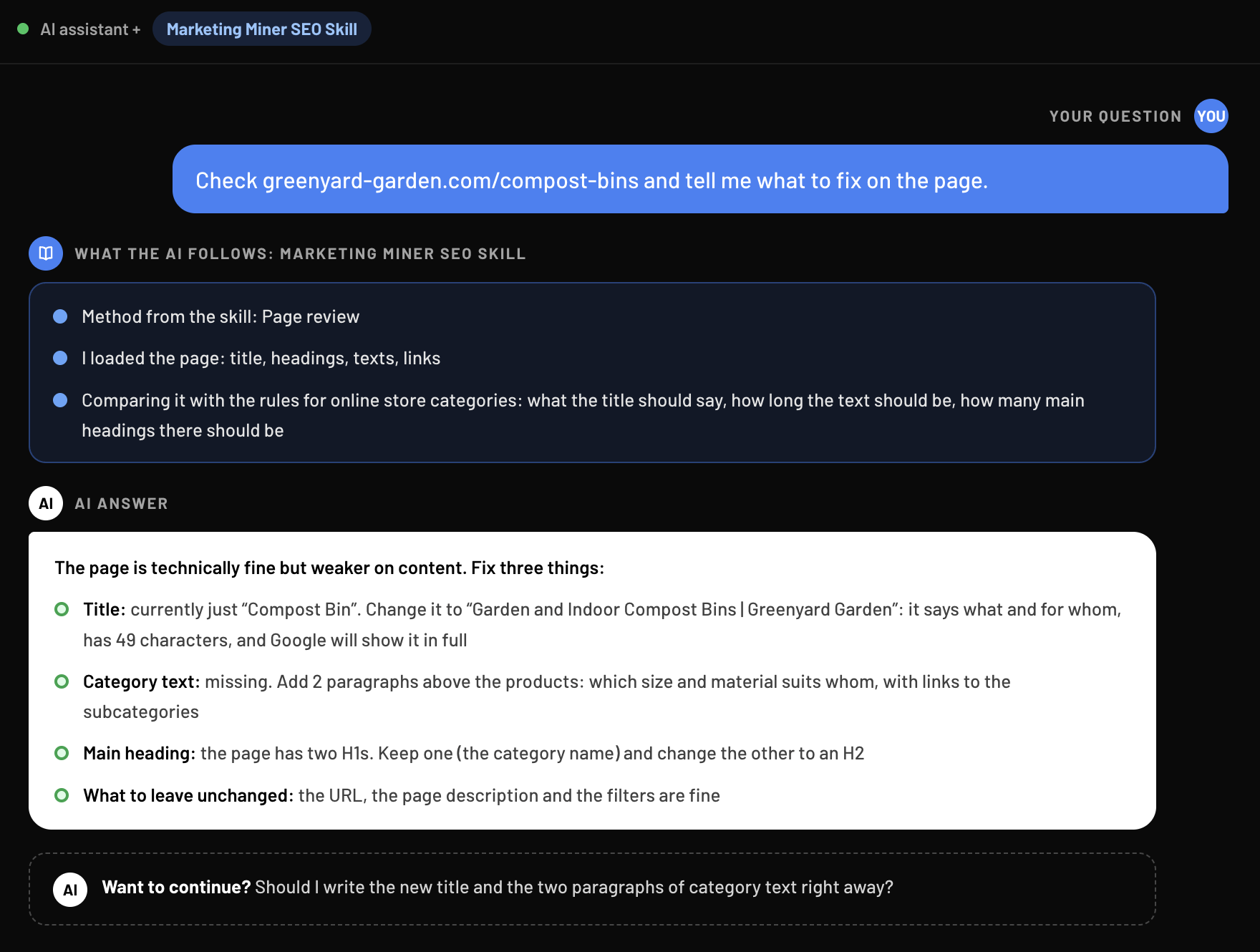
The Marketing Miner SEO Skill is completely free. Just create a free Marketing Miner account, download the skill, and add it to your AI assistant. You can also test-drive the optional Marketing Miner MCP integration free for 10 days.
Get the Marketing Miner SEO Skill for free
3. Multi-country and multi-device filtering arrives in Google Search Console
Google continues to roll out practical Search Console improvements, this time bringing a welcome quality-of-life update for anyone managing multi-market websites. In early October, Google officially announced the ability to select multiple countries at once in the Performance report to view aggregate organic search performance.
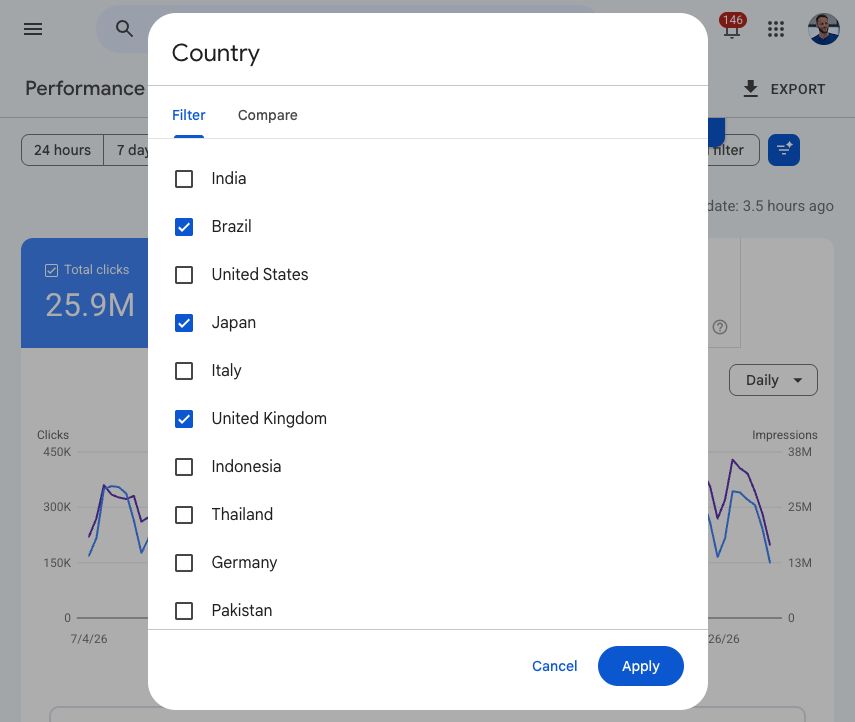
Previously, you could only filter by a single country or compare two countries against each other. Evaluating the overall performance of a specific regional market group meant exporting the raw data and stitching it together in Google Sheets or Looker Studio. Now, you can simply select multiple target countries directly in the filter, and Search Console displays their combined metrics - including clicks, impressions, CTR, and average position. This makes it effortless to evaluate your combined organic performance across, for example, the US and the UK.
And there is more. In early November, Barry Schwartz reported on Search Engine Roundtable that Google quietly expanded this exact same multi-select capability to devices. You can now aggregate data from mobile and tablet, for instance, without having to analyze each device segment in isolation.
For SEO specialists, marketers, and e-commerce teams, this is a subtle but hugely practical update that streamlines organic performance analysis across markets and devices, saving valuable time on recurring reporting. For full details on the new filtering options, check out Google's official documentation.
4. Google serves poisoned SERPs to SEO tools. How reliable is your rank tracking?
Since mid-September, SEO tool providers have been grappling with a major issue. Google has started aggressively serving altered or fake search results - widely referred to as poisoned SERPs - to automated scrapers and rank tracking systems. Because these results differ significantly from what real users see, SEO tools have been logging sudden ranking drops and severe volatility that never actually occurred.
The issue was highlighted by publications like Search Engine Journal, with platforms such as Ahrefs confirming its widespread impact. According to a large-scale study by Nozzle analyzing 56 million search results, on the worst day (September 30, 2026), up to 43.5% of analyzed results were altered. Worse still, in 61% of those tainted SERPs, the tracked website seemingly plummeted out of the top 10, even though its real-world ranking remained completely unaffected.
To tackle this, we deployed several safeguards at Marketing Miner to detect and isolate skewed results early. During development, we cross-referenced our rank tracking data with real Google Search Console metrics to accurately identify when Google is serving a poisoned SERP. Our algorithm now automatically inspects all collected data - and if it flags suspicious volatility, we re-run the check at our own expense (multiple times if necessary) to prevent corrupted data from polluting your reports.
Thanks to these measures, Marketing Miner achieves industry-leading rank tracking accuracy. While many other SEO tools record poisoned SERPs as real ranking shifts, we rigorously verify suspicious data before logging it. Learn more about how we ensure data quality.
Is your SEO tool tracking rankings accurately? We'll gladly run a free side-by-side comparison against Marketing Miner to help you spot data inaccuracies and phantom ranking drops.
Audit your rank tracking for free
5. Google updates AI Overviews and AI Mode. Will more links actually drive more traffic?
Google continues to refine its AI search experience, this time zeroing in on link displays within AI Overviews and AI Mode to make it easier for users to jump to publisher websites and primary sources.
According to Google’s official announcement on October 15, 2026, users can expect more clickable inline links embedded directly within AI-generated responses - placed in significantly more prominent spots. Google is also testing more distinctive links to official websites, expanding recent article carousels to additional languages and markets, and refining how related content is surfaced with image thumbnails. In AI Mode, they are also experimenting with clickable author and publisher profiles on video content. As usual, Google is rolling these updates out gradually, and availability may vary by region and language.
The explicit goal of these tweaks is to encourage users to click through from AI answers to original source websites. But the big question remains: will more prominent links actually translate into meaningful organic traffic?
Renowned SEO expert Barry Schwartz echoed this skepticism on Search Engine Land. He pointed out that while Google is visibly trying to incentivize click-throughs, it's debatable whether searchers will bother visiting an external site if the AI already satisfies their query right in the SERP. Schwartz also called out the lingering data gap in Google Search Console. Although Google introduced dedicated performance reports for AI search back in June 2026 - reporting impressions across AI Overviews and AI Mode - they still omit click data, leaving marketers unable to measure the actual business impact of these updates.
Marketing Miner TIP: With our AI visibility tracking tool in Marketing Miner, you can monitor how often your brand and URLs surface across Google AI Overviews, AI Mode, ChatGPT, Gemini, and Perplexity. Benchmark your visibility against competitors and pinpoint the exact sources AI assistants cite to formulate their answers.
6. Running a Shoptet store? Grab 24 actionable SEO and GEO prompts from Reshoper
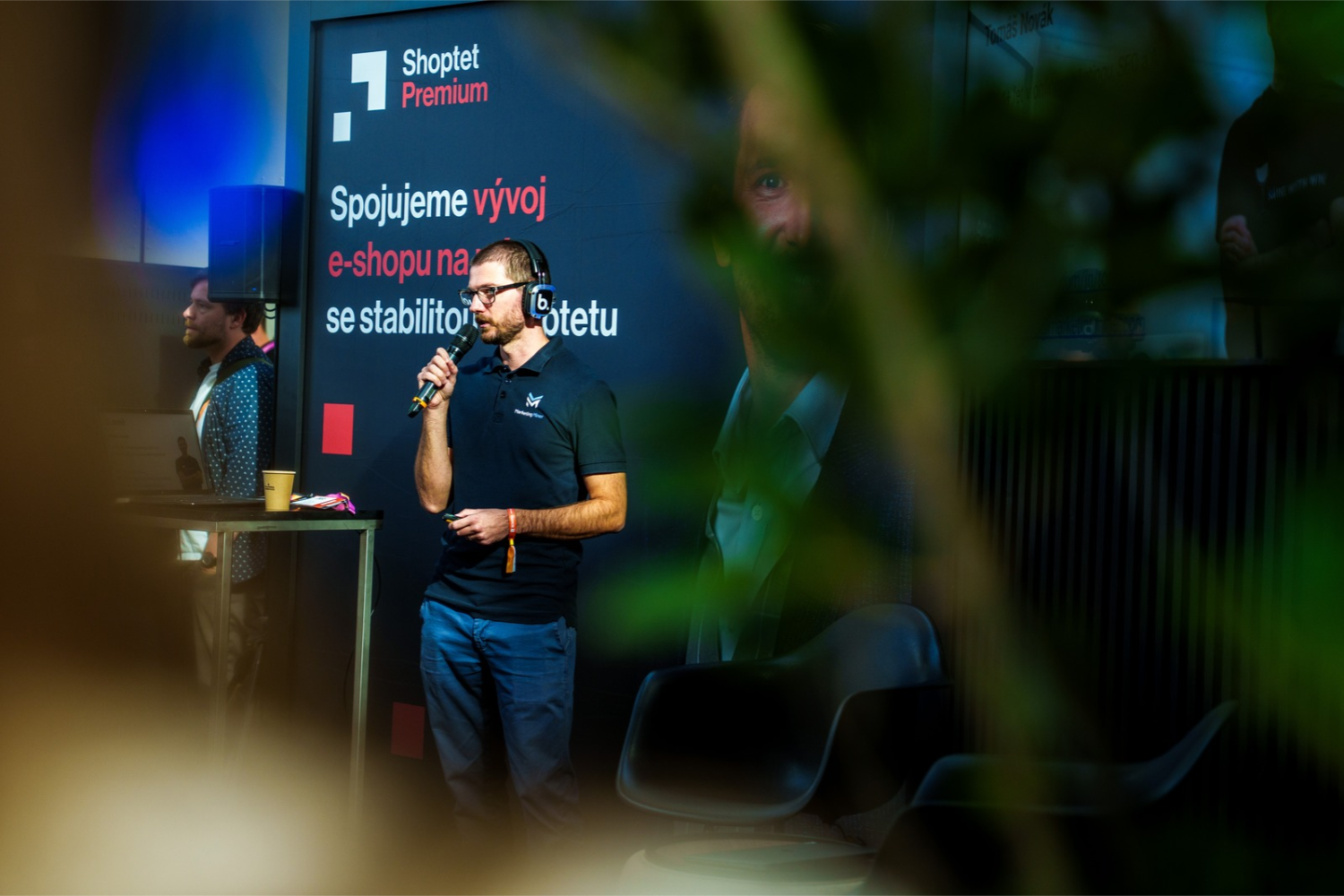
In October, the Marketing Miner team headed to Reshoper 2026 - the premier Czech e-commerce expo - where we introduced our new Shoptet add-on: AI Visibility and SEO. Marketing Miner CEO Tomáš Novák also took the stage with his keynote: “How to easily drive search revenue using AI (SEO & GEO).” If you couldn't make it to Reshoper and run your e-commerce store on Shoptet, we’ve got two exclusive bonuses lined up for you.
First is a curated set of 24 actionable prompts for ChatGPT, Claude, and other AI assistants designed to help optimize your store for both traditional search and generative engines (GEO). You get 4 comprehensive frameworks and 20 targeted prompts that you can plug directly into real search volume and competitive data. The second bonus is the complete 69-slide presentation deck from Tomáš's talk, so you can revisit the strategies and test them out in practice at your own pace.
You’ll find both bonuses inside our AI Visibility and SEO Shoptet add-on. Beyond the freebies, the tool lets you track your store’s visibility across Google and AI assistants, benchmark against competitors, and optimize product pages to rank higher in both organic and generative search. You can test-drive the add-on with a free 30-day trial - no strings attached. Once installed and logged in, simply click the Reshoper bonus tab in the main navigation menu to unlock your prompts and slides.
Try the Shoptet add-on and claim your bonuses
7. How to build backlinks that Google actually values: 5 practical recommendations
Backlinks remain a fundamental ranking factor. However, not all links carry equal weight - and Google can easily discount or ignore links that add no real value. So how do you build backlinks that actually move the needle for your SEO? Renowned SEO expert Cyrus Shepard - founder of Zyppy and former Head of SEO at Moz - tackles this exact challenge in his latest deep dive.
Drawing from the leaked Google API documentation, search patents, and public resources, Shepard outlines five practical recommendations for building a high-authority backlink profile. He highlights the critical importance of referring domain trust, topical relevance, and the natural editorial context surrounding each link. One particularly compelling insight is that Google likely evaluates not just the anchor text itself, but also the surrounding words and co-occurring text. Shepard also cautions that artificially varying anchor texts won't necessarily prevent Google from flagging an unnatural link profile.
Shepard’s article is an exceptional practical guide that serves as both a solid refresher on foundational link-building principles and an eye-opening look into how Google evaluates link equity today. If you want to strengthen your website’s or e-commerce store’s backlink profile, we highly recommend reading his full breakdown.
8. Google launches UGC Fresh Data Program to surface user-generated content faster
In early October, Google unveiled its new UGC Fresh Data Program, designed to accelerate how fresh, high-quality User-Generated Content (UGC) surfaces in search results. The initiative is tailored specifically for large-scale discussion and community platforms - such as Reddit - allowing them to feed new threads, comments, and posts directly to Google via a dedicated interface much faster than traditional crawling allows.
Beyond raw content, participating platforms can also supply user engagement signals, such as reaction and comment counts. According to Google’s official documentation, the program aims to help timely discussions and authentic first-hand experiences populate various Google Search features with minimal latency.
Crucially, the program is not intended for standard websites or e-commerce stores. As Barry Schwartz pointed out on Search Engine Roundtable, this is an isolated mechanism that runs completely independently of standard Googlebot crawling and the Google Indexing API. Access is restricted to approved platforms with massive volumes of publicly accessible UGC, active content moderation, and the required technical infrastructure. Furthermore, participation does not guarantee indexing or preferential search rankings.
For SEO professionals, this provides a clear signal of Google’s strategic direction: a continued push toward prioritizing real-time discussions, authentic user experiences, and genuine peer recommendations. However, just how noticeably this program will reshape the SERPs in the long run remains to be seen.
Jana Husníková