
The way people search for information has fundamentally shifted with the arrival of AI assistants like ChatGPT, Gemini, and Google’s AI Mode. For brands, it’s no longer enough to simply monitor how they perform in traditional search results. At Marketing Miner, we’ve responded to these changes - you can now track your visibility in AI models not just as a one-off analysis, but regularly on a daily or weekly basis. But this new feature brings a crucial question: Which prompts should you actually be tracking?
How AI Visibility Tracking Differs from Traditional Rank Tracking
In traditional search, the principle is simple - a user enters a specific term, like "best coffee machines," and you see your position in the search results. Tracking success in AI models, however, requires a completely different approach.
People interact with AI assistants using natural language. Everyone asks slightly differently, creating an infinite number of unique and highly specific queries. Furthermore, responses are generated in real-time, are subject to personalization, and the platforms themselves don't (yet) provide data on exactly what users are typing or how often.
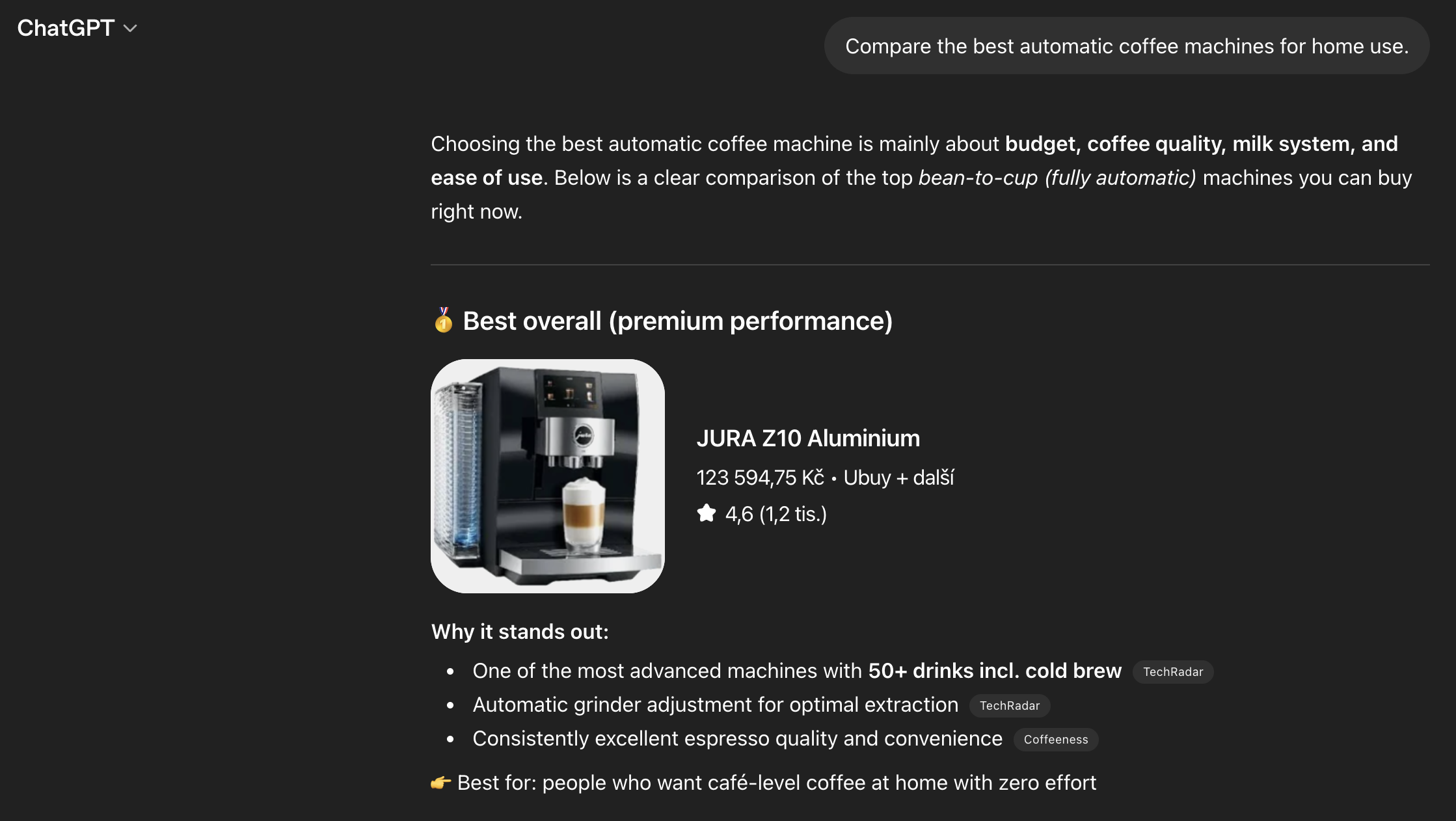
AI Visibility tracking isn't about chasing the "number one spot." It’s about understanding how AI assistants perceive you as an authority within a given topic. So, how do you navigate this "black box" and set up tracking that makes business sense and gives you the most accurate picture of your AI market strength?
Track Your AI Presence Using Prompt Clusters
Since it’s impossible to track every single query users might ask an AI, we recommend using the prompt clustering method. In practice, this means that for each product category, you don't create just one query, but a whole set (cluster) of different prompt variations.
Instead of tracking a specific "position," you monitor your Share of Voice (SoV) within that topic. If your brand appears in, say, 80% of the responses within a cluster, the AI perceives you as an authority. If you only appear in 10% of cases, it’s a clear signal to work on your content and site authority.
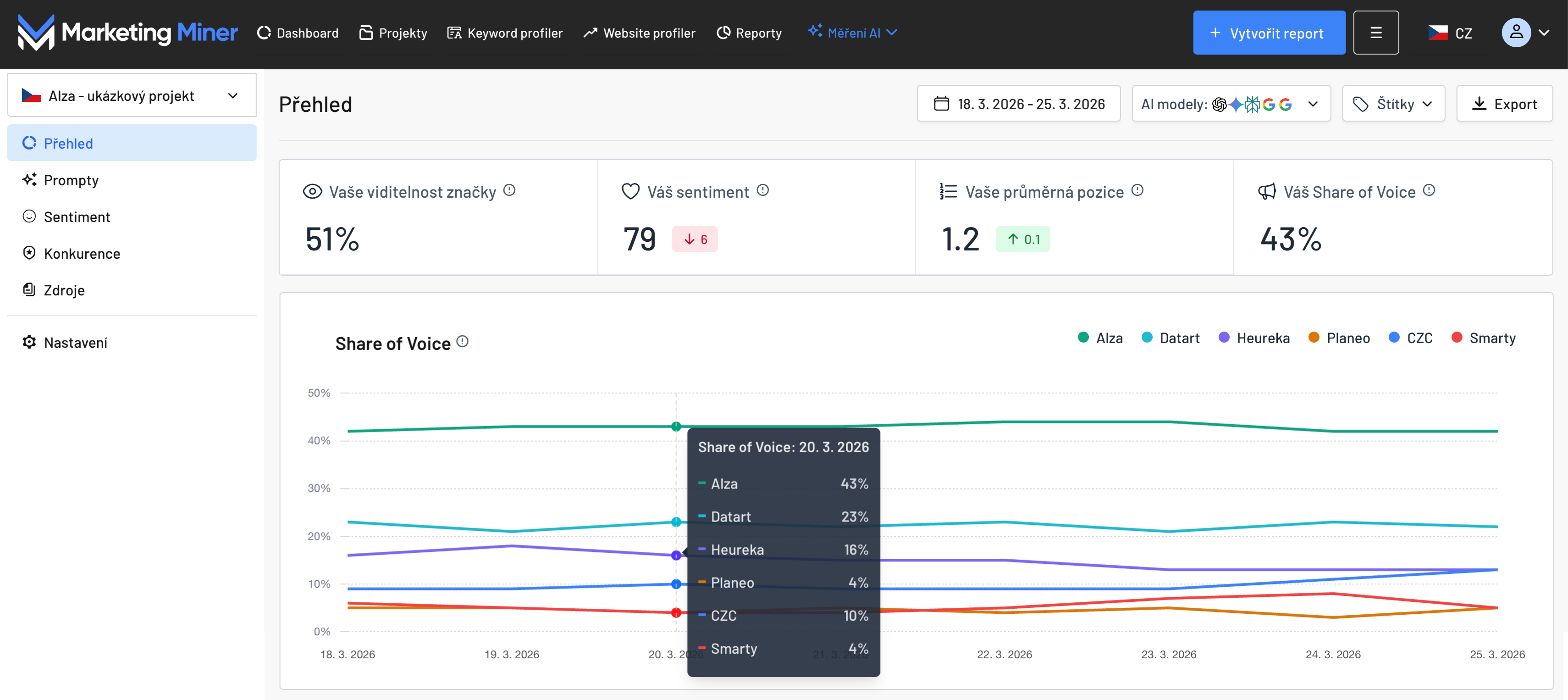
Share of Voice trends in Marketing Miner’s regular AI visibility tracking
You can define these clusters by intent, the marketing funnel stage, or specific products and services. For the most accurate data, we recommend separating branded queries (containing your brand name) from product and general queries into distinct groups.
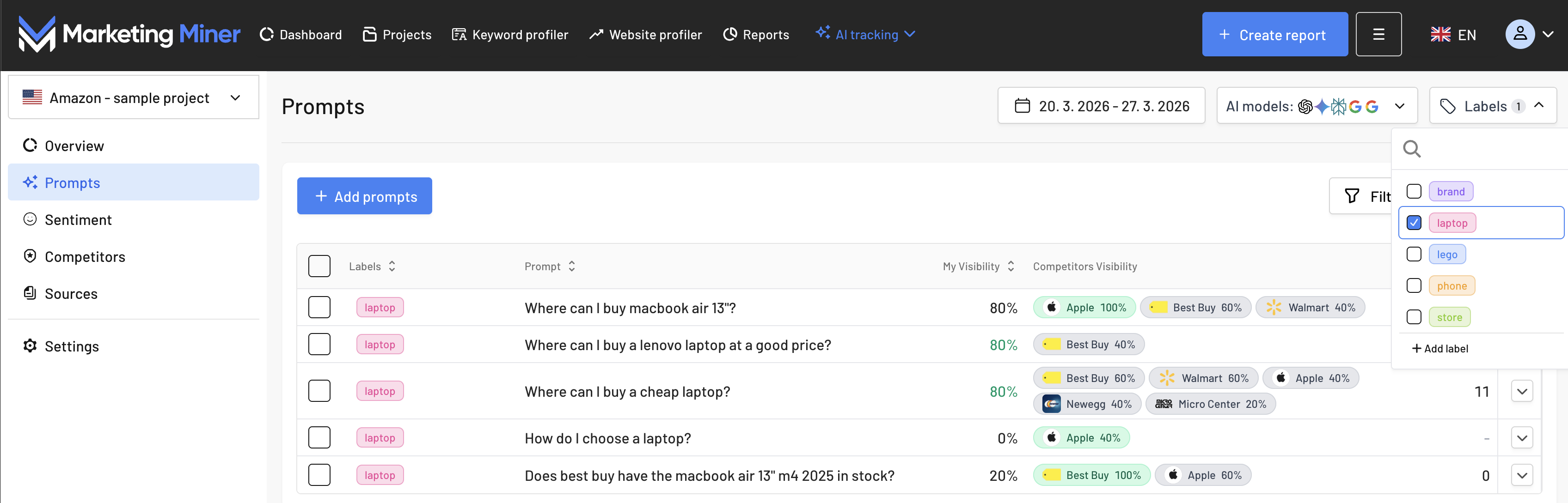
To make evaluating entire topics as easy as possible, you can easily group your prompts using labels in Marketing Miner. This gives you a clear overview of how your brand performs in a specific product category or at a certain stage of the buyer’s journey.
Marketing Miner TIP: For very general prompts, AI models often rely solely on their training data and don’t trigger a web search. If you want to get up-to-date information and web citations, add a time specification to the prompt, such as the current year or month.
Best Practices for AI Visibility Tracking
Before you start collecting data, keep these rules in mind:
- Don’t focus solely on individual prompt results. Group prompts into clusters and evaluate the overall trend within a topic.
- Don’t think of prompt tracking as traditional rank tracking. Understand that your "position" in responses is highly volatile. Your presence in the AI response itself is what matters. At Marketing Miner, we track not only if your brand is listed as a source but also if it appears directly within the text of the AI response.
- Monitor your Share of Voice. How often do AI assistants recommend you compared to your competitors?
- Don’t try to track everything - prioritize. Focus on the key products and services that are most important to your business.
- Don’t treat AI tracking as a "set and forget" task. AI learns and sources change, manage your AI visibility continuously. If an AI isn't mentioning you, find out which sites it is citing instead and try to get featured there - for example, through PR or link building.
Now that you have a better idea of how to work with prompts, let’s look at the specific data sources that will help you identify exactly which queries you should be tracking.
AI Visibility Tracking in Marketing Miner
5 Key Sources for Finding AI Tracking Prompts
Since AI platforms (unlike search engines) don't currently provide data on what users are typing into their chats, we recommend working with synthetic prompts. These are naturally formulated queries created based on real search data where you already know the popularity and search volume.
While these "artificially created" variations won't be a 100% mirror of every AI conversation, they will help you effectively prioritize topics people are genuinely interested in. Here are 5 proven ways to get these prompts:
1. Google Search Console Queries
Use the questions for which your site already appears in organic search and gains impressions. These real queries are a great foundation for your tracking clusters.
How to do it: Open Google Search Console and use a Custom (Regex) filter in the Performance tab to isolate questions. The following regex is perfect for filtering for question-based queries (separate multiple terms with a pipe symbol):
^(who|what|where|when|why|how|can|is|are|will|does|should|do)\b
Once you have this list, use AI to transform these queries into a natural, conversational format.
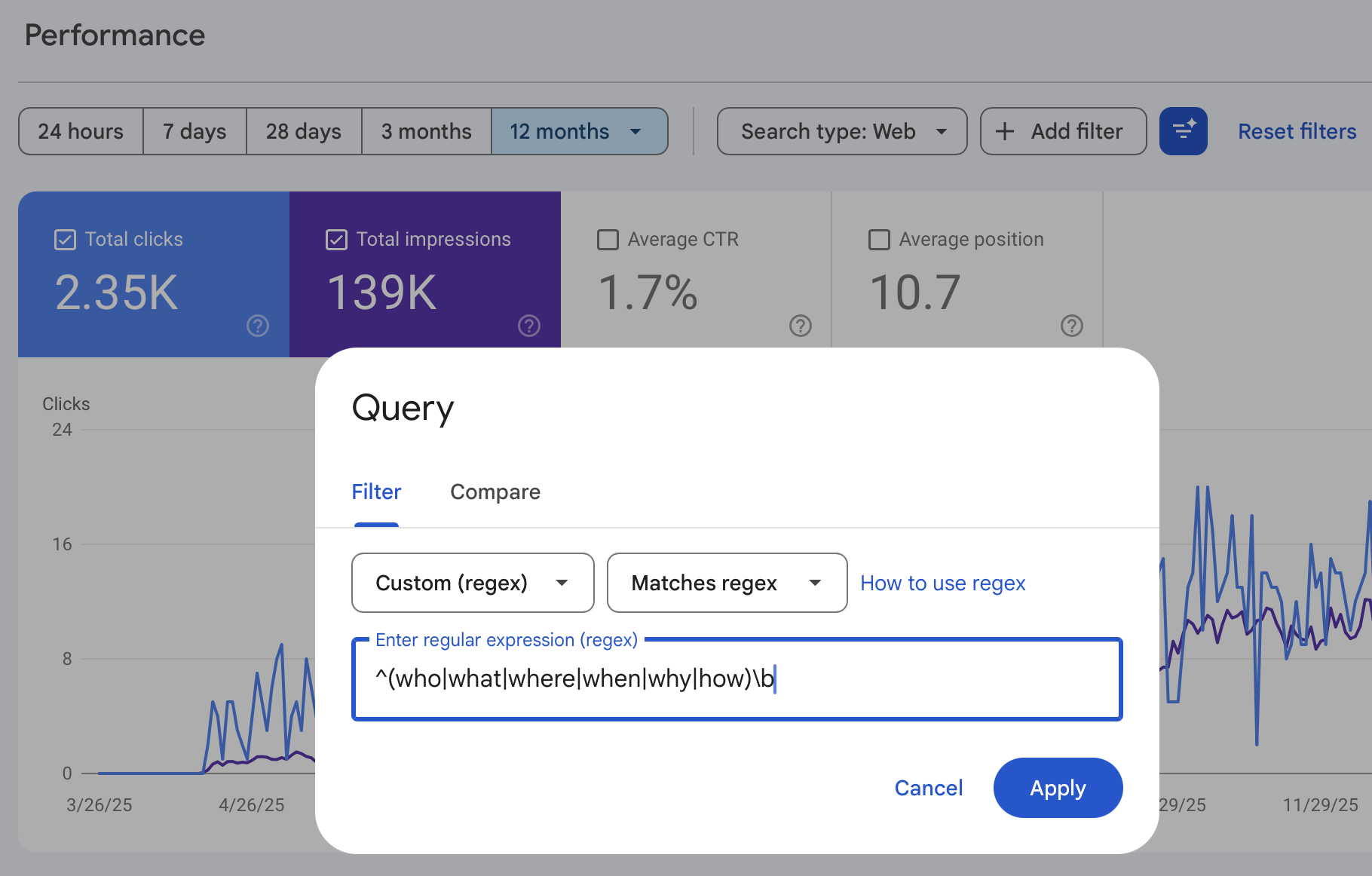
Filtering for questions in Google Search Console using Regex
2. Generating Transactional Prompts for Key Products
To see how your brand performs in AI search, convert the keywords for your core products and services into natural speech. Use an AI assistant to generate conversational variations of buying queries.
Example: Instead of tracking "Scott mountain bike," your prompt might be: "I'm looking for a lightweight Scott mountain bike for a beginner under $1,500, what would you recommend?"
Beyond transactional prompts, you can also track conversational queries generated from the keywords that drive organic traffic to your top-performing pages.
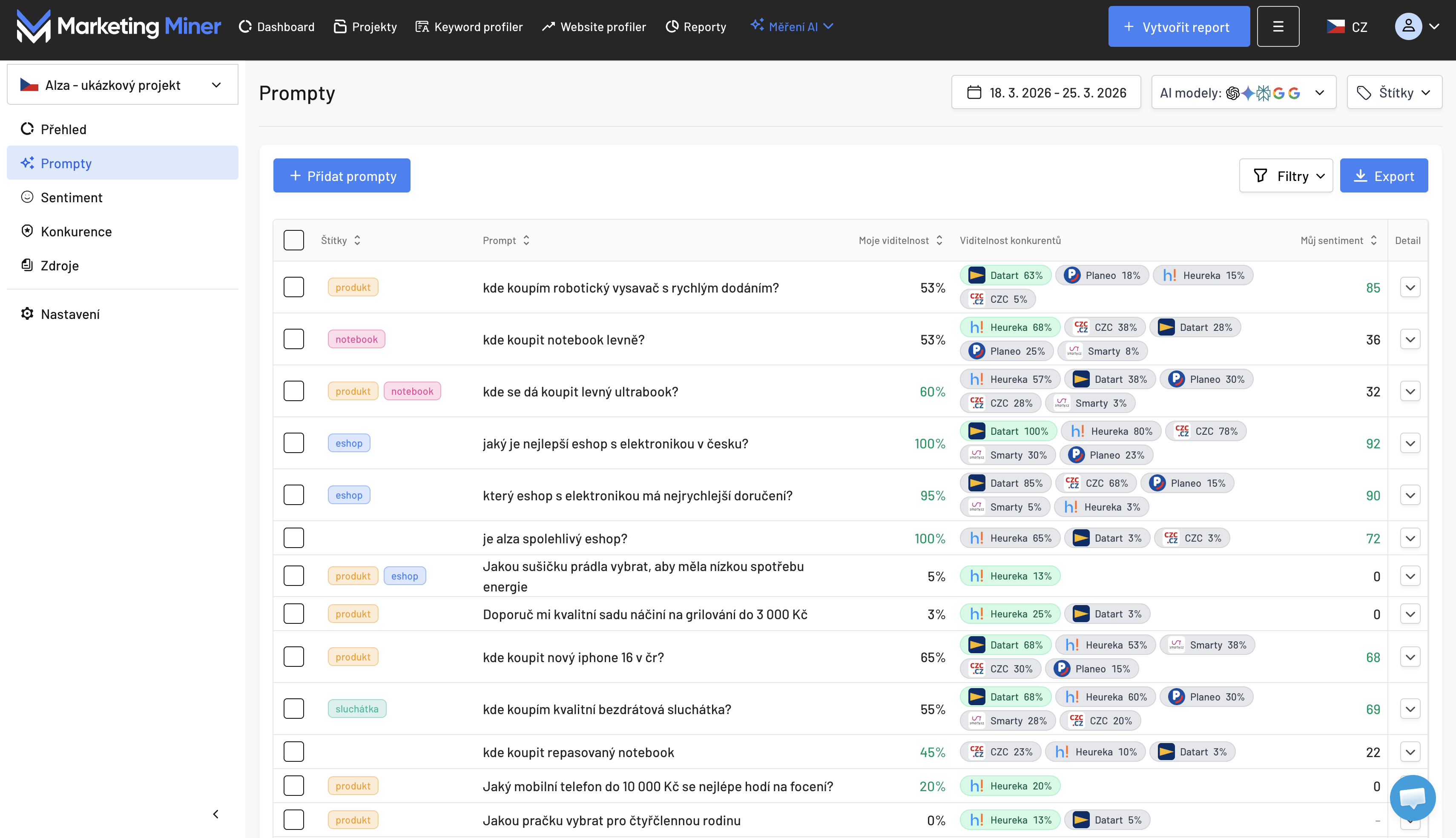
Prompt examples in Marketing Miner’s AI visibility tracking
3. Discussions and Forums
While websites often have perfectly optimized titles, forum posts are much closer to how people naturally write. Users on forums don't care about "ranking." Look at the problems your customers are solving on Reddit or industry-specific forums to find inspiration for naturally phrased questions.
4. "People Also Ask" (PAA) in Google Search
Google directly shows related questions in the SERP. As soon as you click a heading to expand it, Google offers even more suggested queries. These are perfect for your AI visibility clusters.
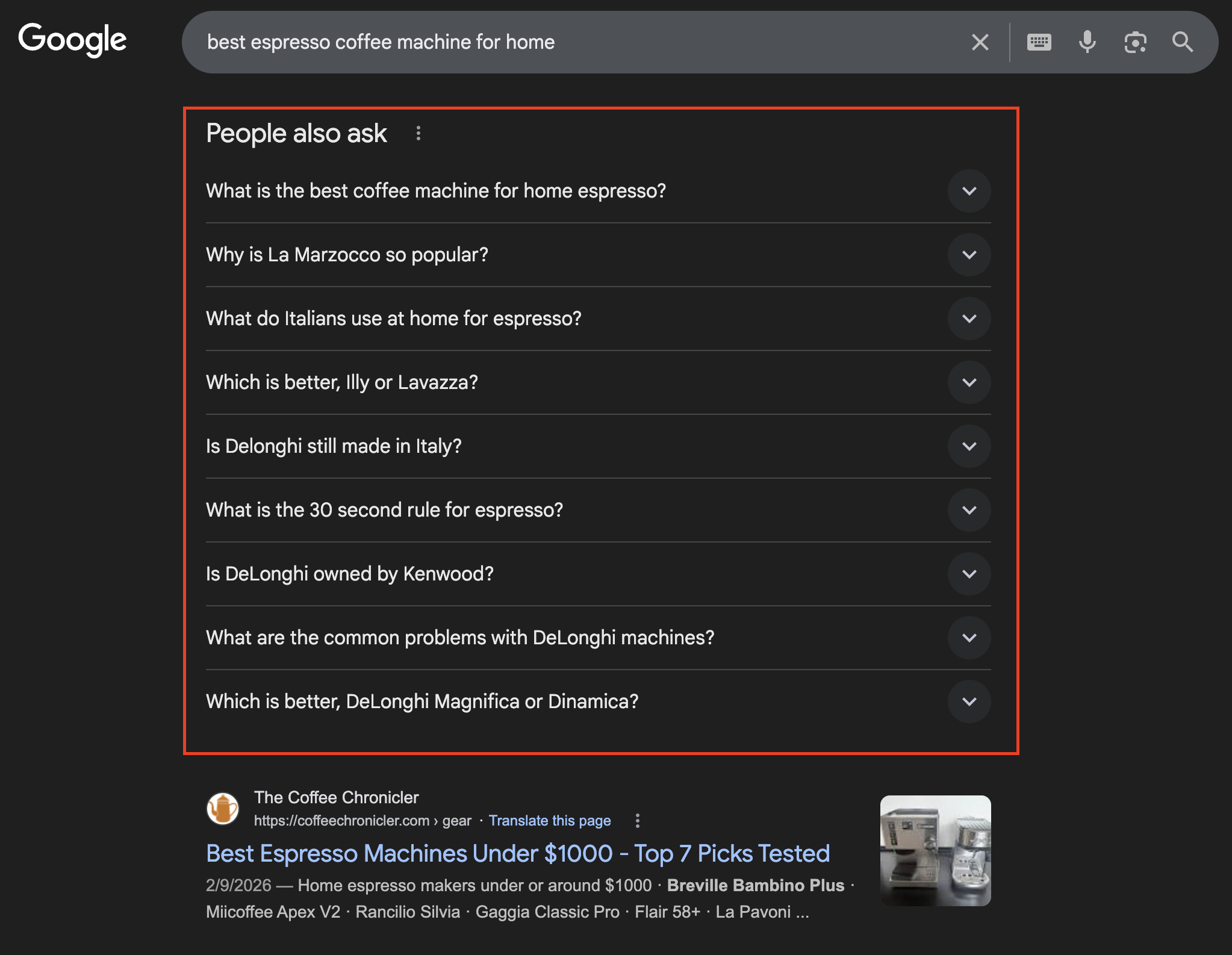
Example of the 'People Also Ask' section in Google search
5. Marketing Miner - Keyword Profiler (Questions)
You can also get inspiration directly in Marketing Miner using the Keyword Profiler tool. Simply enter a keyword, and in the Questions tab, you’ll immediately see what people are most frequently asking about the topic. These are ideal because you can see the real search volume for each question, ensuring you track topics that users actually care about.
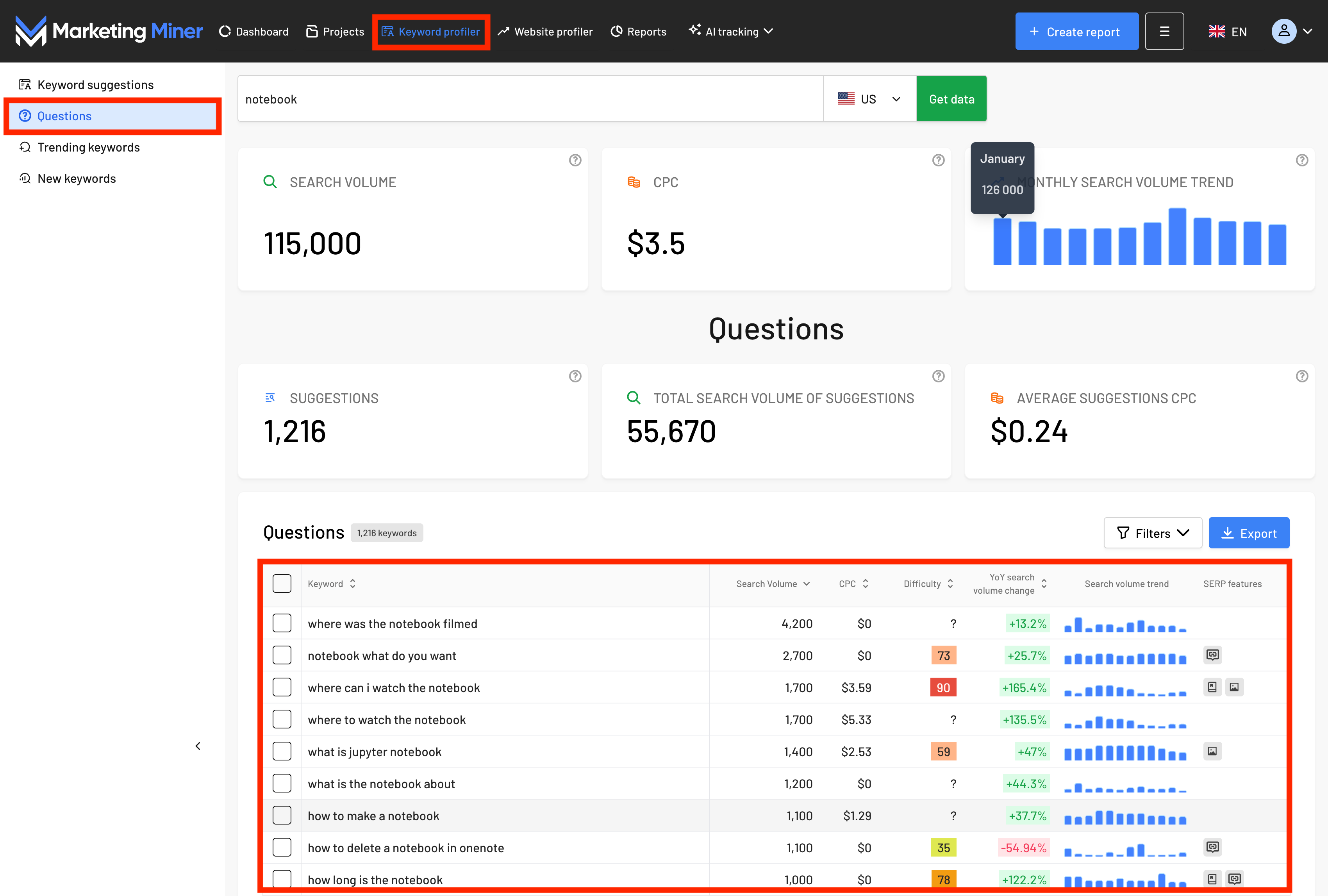
Example of user search queries in Marketing Miner’s Keyword Profiler
How to Set Up Regular AI Visibility Tracking
Once your prompt clusters are ready, simply paste them into Marketing Miner to start regularly tracking the AI visibility of your brand and competitors. In an environment where models like ChatGPT, Gemini, Perplexity, and AI Overviews change almost by the hour, continuous tracking is the only way to get truly relevant insights.
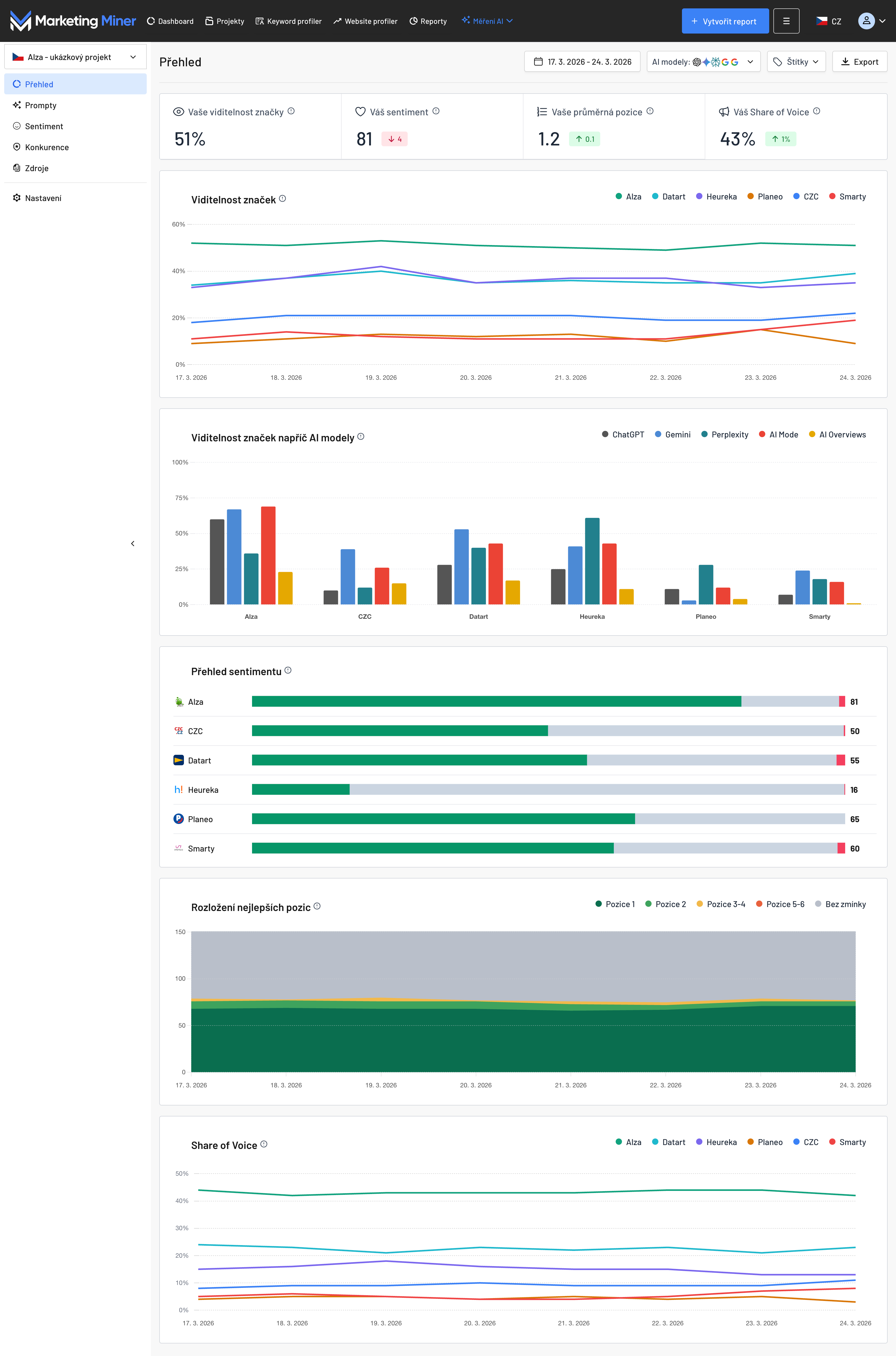
Marketing Miner will regularly:
- Track AI Visibility, Sentiment, Average Position, and Share of Voice - see how your brand evolves compared to the competition.
- Analyze Prompts in Detail - discover your success rate and the "winner" for every query.
- Analyze Sources - find out which specific URLs and websites AI models used for their answers.
- Benchmark Against Competitors - see visibility and position trends for your brand and up to 5 rivals.
Don’t lose track of how AI assistants are presenting your brand to your customers. For a step-by-step guide on how to set up tracking in just a few clicks, check out our dedicated article.