
7 Key SEO & AI News You Need to Know - April 2026
If you thought March was intense, April 2026 has really upped the ante. This month's highlights include a fix for a critical reporting error in Google Search Console, the looming shift toward "Agentic Search," and our latest research on AI brand visibility in the Czech market. We’ve also included an invite to a hands-on Marketing Miner webinar.
1) Webinar Invite: Live AI Visibility Audit - Pavel Ungr & Tomáš Novák
Do you know how your site is surfacing in ChatGPT, Perplexity, Gemini, or Google AI Overviews? In this hands-on webinar, we’ll show you actionable steps to increase your citation rate and establish your brand as a topical authority for AI assistants.

Joining forces with Pavel Ungr, we’ll be breaking down three real-world websites live. We’ll expose the gaps and hidden opportunities that define success in generative search in 2026. You’ll gain expert insights into AI-era content strategy and get a first look at the tools we use to measure and analyze AI visibility.
See you on Tuesday, May 12, 2026, at 10:00 AM (CET). Please note that the webinar will be held in Czech.
Want us to audit your site? Submit your URL via the registration form - we’ll be picking three sites for the live session.
2) Marketing Miner Study: AI Brand Visibility in the Czech Market
AI assistants are rapidly becoming a key interface for consumer decision-making. With ChatGPT hitting 900 million weekly users, Gemini exceeding 750 million monthly users, and Google AI Overviews reaching 2 billion, we are witnessing a massive shift in user behavior. For brands, classic search visibility is no longer enough - you need to be the authority that AI models actively recommend.
The ability to measure and influence AI visibility is becoming the new benchmark for competitiveness. This is why we’ve conducted an extensive study of AI brand visibility in the Czech market to map out how brands are performing in this new ecosystem.
We analyzed 400,000 data points based on 100,000 unique prompts across ten major industries within ChatGPT, Gemini, Perplexity, and Google AI Overviews. Discover which brands are dominating AI-generated answers.
3) Google Search Console Fixes Year-Long Data Logging Error That Skewed Impressions
If you’re seeing a sharp decline in your Google Search Console (GSC) impressions this April, don't panic - it might not be a loss of visibility. After nearly 11 months, Google has finally admitted to a major data logging error. According to the official Data Anomalies page, impressions have been artificially inflated since May 13, 2025.
Only impression and CTR data were affected; clicks and other metrics remain accurate. Google stated that the fix will roll out over the next few weeks, and sites should expect to see a drop in reported impressions during this period.
Search Engine Journal confirmed that teams reporting on impression-based metrics over the past year have been working with inflated numbers. Search Engine Roundtable described the anomaly as the "alligator effect" - a visual widening in GSC charts where impressions skyrocketed while clicks stayed flat. This artificial surge caused reported CTRs to appear much lower than they actually were.
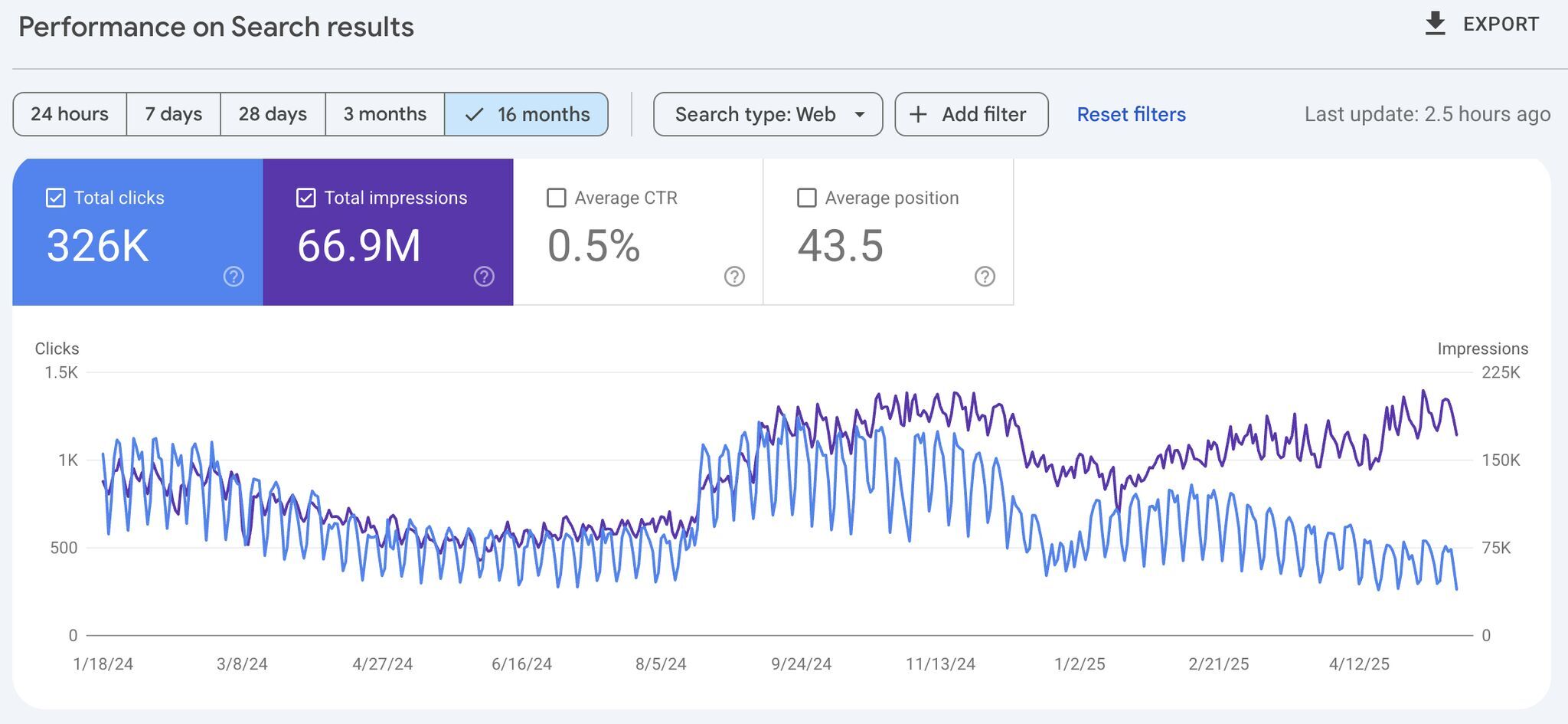
Source: Search Engine Roundtable
What the experts are saying? Brodie Clark, an independent SEO consultant, flagged the issue on X (formerly Twitter) on March 30 - four days before Google’s admission. He noted:
"Heads-up: there is something bizarre going on with Google Search Console data right now. Similar to the changes that came to light after the disabling of &num=100, impressions are again skyrocketing for specific surfaces on desktop."
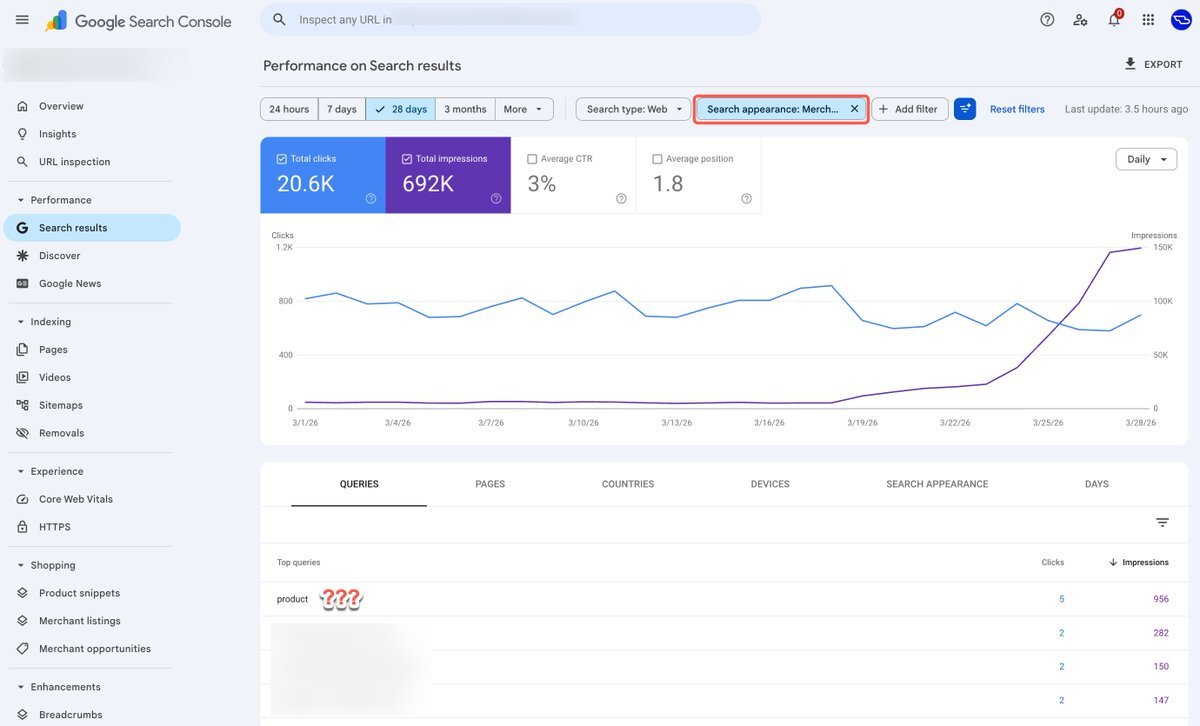
Source: Brodie Clark, platform X
Chris Long, co-founder of Nectiv, added on LinkedIn:
"Holy moly SEOs. It turns out Google has been accidentally inflating impressions in Search Console reports for ALMOST A YEAR."
Actionable Advice from Pavel Ungr: Since Google will not retroactively fix historical data, it will remain permanently distorted in GSC. Pavel recommends adding annotations to all reporting tools (Looker Studio, custom dashboards, etc.) for May 13, 2025, and the date the fix is finalized.
"Add an annotation to all your reporting tools for May 13, 2025, and the date the fix is finalized. Looker Studio, custom dashboards - wherever you track data over time. You’ll need this annotation for every YoY comparison for at least the next year. Reach out to clients who receive regular reports before the fix is fully rolled out. The coming drop in impressions isn't the result of an algorithm update or a performance dip. Anyone who receives a report with a significant drop without context is going to start calling."
4) From Search to Action - Google Pilots "Agentic Search" in the US
While the focus has been on how AI summarizes information, Google launched a live pilot of Agentic Search (task-oriented search) in the US this April. As Search Engine Journal reports, this moves beyond mere text generation; it’s about the ability of AI models to execute specific tasks directly within the search interface.
A prime example is a query like: "Plan a trip to SEO Vibes in Zakopane for two, find a wellness hotel, and book a table for Friday dinner." Thanks to Canvas integration and new agentic capabilities, the search engine doesn't just return a list of links - it builds a complete itinerary. You can then finalize bookings via integrated partners directly in the SERP, without ever visiting a third-party website.
Google CEO Sundar Pichai confirmed this shift in an April interview:
"Information seeking queries will be agentic search."
Pichai envisions Google as an "agent manager" - an orchestrator overseeing tasks rather than competing with them directly. Experts are already coining the term TBAS (Task-Based Agentic Search) for this phenomenon. At the Cloud Next ‘26 conference, Google also showcased the infrastructure supporting this transition, from the Gemini Enterprise Agent Platform to 8th-generation TPU processors.
What does this mean for your SEO strategy? This shift in user behavior will primarily impact e-commerce and local services. Success in the "agentic era" will depend on:
- Structured Data & APIs - agents need real-time access to your availability and pricing data to include you in their workflows.
- Shortening the Conversion Path - users often won't click through to your site to "read up"; they will perform the action directly within the AI interface. Your goal is to be the fulfillment source the agent selects to complete the task.
- Ecosystem SEO - establishing a presence within the specific ecosystems (Google Business Profile, industry-specific platforms) that agents leverage as their primary data sources.
5) Google Defends AI Overviews Traffic Loss with the Term „Bounce Clicks“
In April 2026, Google’s Head of Search, Liz Reid, made waves in the SEO community during an appearance on the Bloomberg Odd Lots podcast. Addressing concerns regarding organic traffic declines, she introduced the term "Bounce Clicks". Google uses this to describe instances where a user visits a site cited in AI Overviews for only a fraction of a second just to verify a specific fact before immediately bouncing back to the search results.
According to Reid, these "one-second visits" offer minimal value to website owners. Replacing them with direct answers within AI Overviews (AIO) is intended to streamline search efficiency and send users to websites only after they have been "educated" by the AI summary and are ready to dive deeper into a topic. The expected result is lower click volume, but higher-value, high-intent traffic with improved conversion rates.
What does this mean in practice? Websites must brace for a permanent decline in "quick-hit" traffic for informational queries. The goal is no longer to retain users on the page at any cost, but to establish yourself as the authority that the AI selects as its primary source. The key to driving clicks from AI Overviews remains unique data, deep expertise, and comprehensive insights that motivate users to visit the site despite the presence of an automated summary.
Marketing Miner TIP: Stay on top of how you and your competitors are performing in AI Overviews. Use our one-time AIO Visibility Analysis for a quick audit or set up recurring AI visibility tracking in Marketing Miner.
6) AI Visibility Tracking in Marketing Miner - Looker Studio Reports & New Plan Calculator
Tracking visibility in AI-generated answers is rapidly becoming a staple of the modern SEO stack. To streamline how you work with this data and simplify budget planning, we’ve rolled out several new features in Marketing Miner:
- Official Looker Studio Connector - Google has officially approved our connector, allowing you to pull your recurring AI Visibility projects directly into your client dashboards. You can now visualize AI performance data side-by-side with metrics from Google Search Console or GA4.
- AI Plan Calculator - we’ve added an interactive calculator to our AI Visibility page. Simply enter your prompt volume, selected AI models, and tracking frequency (one-time, daily, or weekly), and the tool will calculate your costs and recommend the ideal plan for your projects.
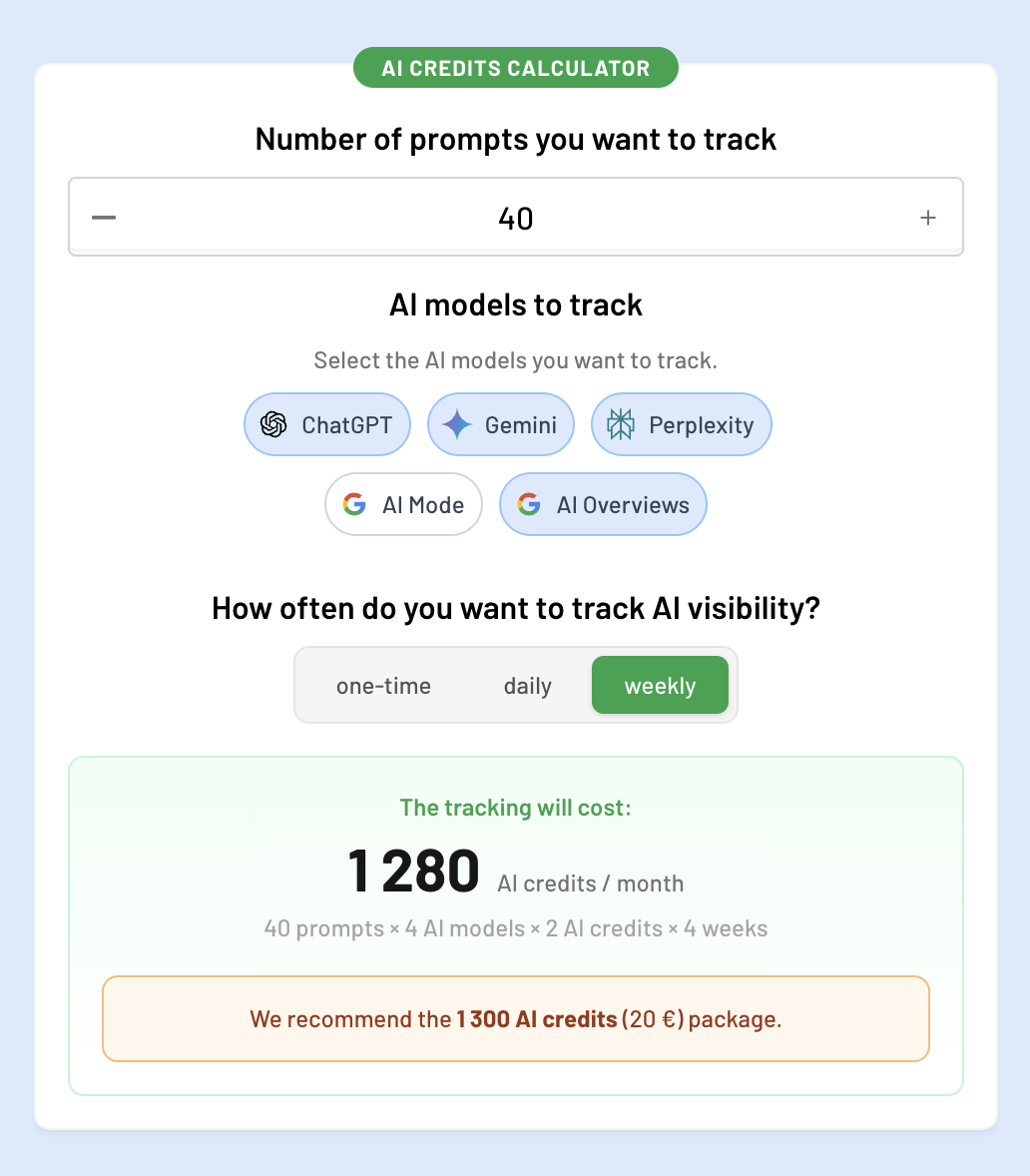
Marketing Miner TIP: Not sure which queries you should be tracking in AI answers? Get inspired by our guide: How to Choose the Right Prompts for AI Visibility Tracking?
7) Google to Discard Spam Reports Containing Personal Data
In April 2026, Google updated its spam reporting system with a new privacy safeguard. To comply with data protection regulations, any report containing Personally Identifiable Information (PII) will no longer be processed. This change addresses the fact that when Google issues a manual action based on a report, they often share the report’s text verbatim with the site owner to provide context for the violation.
The Takeaway: If you include personal details in your report, Google will discard it for security reasons, and you will have to resubmit it - this time keeping it factual and anonymous. This measure prevents your identity from being disclosed to the owner of the reported site. If the report is "clean" of personal data, Google will process it and, if a penalty is issued, forward the text to the site owner. It remains crucial to avoid including anything in your description that could indirectly identify you.